

Writing for Human and AI Reviewers: The New Way to File
The rise of automated FDA AI reviewers means mastering the balance between machine-readable data and clear medical storytelling. It is no longer optional—it is the key to avoiding costly filing delays.

The rise of automated FDA AI reviewers means mastering the balance between machine-readable data and clear medical storytelling. It is no longer optional—it is the key to avoiding costly filing delays.
By Michael Bronfman
May 11, 2026
The world of medicine is changing fast. For decades, pharmaceutical companies followed a simple path: run a study, write a report, and send it to the Food and Drug Administration (FDA). The “audience” was always a group of human scientists. But in 2026, the rules have shifted. Today, when a company submits a new drug application, the first “eyes” on the document might not be human at all.
Smart software and advanced data tools now help regulators look through thousands of pages in seconds. This means that if you are writing a regulatory submission, you are no longer just writing for a doctor or a chemist. You are writing for a machine, too. This double audience requires a whole new way of thinking about how we present science.
Why This Matters Now
The FDA recently released new rules about how companies can use smart technology in their filings. They made a big distinction between “low risk” and “high risk” uses. This matters because it tells companies where they need to be the most careful and spend the most time.
High Risk: If a computer program is used to select which patients receive a drug, determine the dose, or identify safety signals, the FDA looks at it very closely. This is because these tasks directly impact whether a drug is safe for people. This is the area of high scrutiny.
Low Risk: If the technology is just helping with internal office work, scheduling meetings, or organizing files, the requirements are much lighter.
Because of these new rules, companies have to change how they communicate. They have to be clearer and more organized than ever before. If a machine cannot understand your report, it might flag it as a mistake, even if the science is perfect. A flag from a machine can lead to months of delays, costing companies millions of dollars and keeping medicine away from patients who need it.
Writing for the Machine: What Does It Mean?
Machines do not read as we do. They do not look for beautiful prose or clever metaphors. They do not get impressed by fancy vocabulary. Instead, they look for patterns, data points, and absolute consistency. To get a submission through a machine review without any red flags, writers must use a front-loading strategy.
Front Loading Clarity
“Front loading” means putting the most important information at the very beginning of every section. Instead of building up to a conclusion like a mystery novel, you state the conclusion first.
Old way: After reviewing 500 patients over 6 months and checking their blood pressure daily, we found that the drug worked.
New way: The drug reduced blood pressure by 15% in 500 patients. This conclusion is based on a six-month study where…
This helps the machine categorize the information instantly. It creates a “map” for the software to follow.
Avoiding Inconsistencies
One of the biggest reasons a filing gets flagged today is a data mismatch. Imagine you say a drug is 90% effective on page 10, but a table on page 400 says 89.9%. A human might realize it is simply a matter of rounding up and continuing reading. A machine sees a red flag and stops.
To prevent this, companies are now doing AI readiness reviews. This is a step where the company runs its own software on the document before sending it to the government. They look for the same things the FDA’s machines will look for:
Terminology: Using the exact same word for a concept every single time. Do not call it “the medicine” in one spot and “the compound” in another if you want the machine to track it easily.
Cross References: Making sure every link to a chart or table actually works and points to the precise data.
Structure: Following the eCTD format (electronic Common Technical Document) perfectly, so the software knows where to look for information.
The Human Factor: Keeping the Science Real
Even though machines are doing the heavy lifting, humans still make the final decision. A doctor at the FDA still needs to trust that the drug works. This creates a double challenge. You have to be technical enough for a computer but clear enough for a person.
The Problem with “Robot Speak”
Sometimes, when people try to make things easy for computers, the writing becomes stiff and hard to follow. This is a mistake. If a human reviewer gets confused ot just bored, they may start to doubt the work. The best regulatory writing today uses plain language principles.
Short Sentences: Long, winding sentences may confuse both people and software. Aim for 20 words or fewer.
Active Voice: Saying “The study showed…” instead of “It was shown by the study…” makes the facts stand out and defines who is responsible for the action.
Bullet Points: Lists are easy for machines to scan and for busy human reviewers to read quickly during a long workday.
High Scrutiny Areas: Where Accuracy Counts Most
The FDA Guidance for Industry focuses heavily on a few specific areas. If your submission uses advanced tech for these, expect the highest level of checking:
1. Patient Stratification
This is a fancy way of saying that patients are being sorted into groups. If a computer picks which patients will benefit most from a drug based on their DNA or history, the FDA wants to know exactly why. You cannot just say “the computer said so.” You have to explain the logic in a way a human can verify.
2. Dose Optimization
Finding the right amount of medicine to give someone is a science. If you use a machine to find that “perfect dose,” you must prove the machine isn’t making a mistake that could hurt someone. This requires showing the “math” behind the machine’s decision.
3. Real World Data Analysis
Sometimes companies analyze health records from millions of people to see how a drug works in the real world. This is a mountain of data. Machines are great at this, but they can also find patterns that don’t actually exist (called “noise”). Your report must explain how you ensured the data was clean and the patterns were genuine.
4. Safety Signal Detection
This is about finding side effects. If a machine is the first thing to “notice” a side effect in a clinical trial, the documentation must show how that information was passed to human doctors for a final check. The human must always be in the loop.
The Importance of Pre-Submission Checks
In the old days, a team would proofread a document for typos and then send it off. In 2026, that is not enough. The “Internal AI Readiness Review” is now a required step for any serious pharma company.
This process involves using tools to “stress test” the document. For example, the team asks:
“Can a computer find the primary endpoint in less than one second?”
“Are there any hidden characters or weird formatting that will break the FDA’s software?”
According to Clinical Leader experts, companies that skip this step often face “Refusal to File” letters. This means the FDA will not even look at the science because the document itself is too messy for their tools to handle.
The Role of the Medical Writer in 2026
The job of a medical writer has changed. It is no longer just about writing; it is about information architecture. A writer today must understand how data flows from the lab into a table and convey that with a paragraph.
They act as a bridge. On one side, they have the data scientists who talk in code and numbers. On the other side, they have the regulators who want to ensure public safety. The writer must translate complex data into a structured format that satisfies both software scanners and human doctors. This requires a deep understanding of the eCTD structure and the ability to write with mathematical precision.
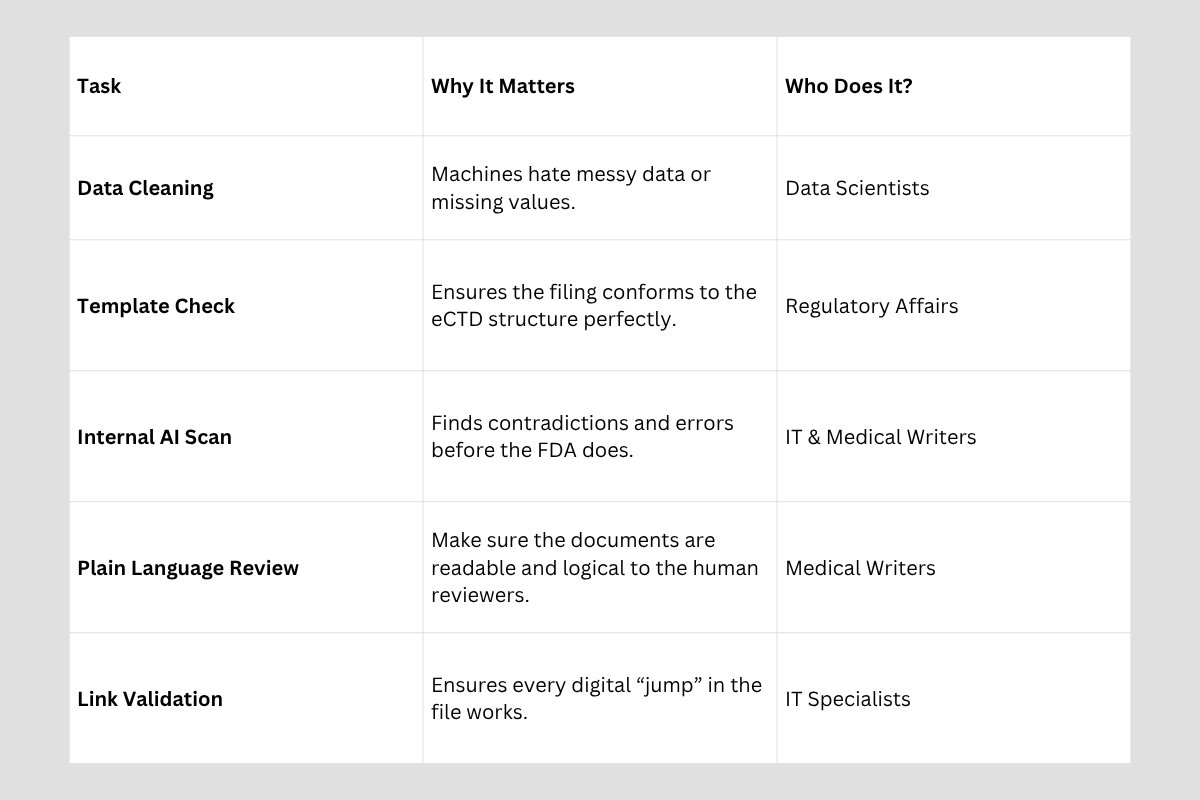
How to Prepare: A Practical Checklist
If you are working on a pharma team, you cannot wait until the last minute to think about these things. Preparation starts months before the “submit” button is pushed.
Ethics and Transparency: The “Explainable” Requirement
One thing a machine cannot do is be ethical. It cannot think about the spirit of the law or the “heart” of a patient. That is why transparency is the biggest buzzword in 2026.
When you use a machine to help write or analyze a filing, you must be honest about it. You must show the pathway the machine followed to reach its answer. This is often called Explainable AI. If a regulator can see the steps, they can trust the result. If the process is obscured, a “black box” in which no one knows how the answer was derived, the FDA will likely reject it.
Bridging the Gap
Writing for both human and machine reviewers is a new skill, but it is one that every professional in the pharmaceutical industry needs to learn. By focusing on structure, consistency, and clear language, companies can get life-saving drugs to patients faster.
The goal should not be to let the machines take over the process. Instead, the goal is to use the machines to make our work more accurate and organized. This allows FDA staff to spend less time looking for errors and more time examining the science. When we write for both audiences, everyone wins—especially the patients waiting for new treatments.
For more information on the technical side of these filings and to stay updated on new research, you can explore the Wiley Online Library.
Key Takeaways for understanding
Machines are now helping regulators read drug reports. Because of this, we have to write in a way that doesn’t confuse the software.
Consistency is king. If you use different words for the same thing or have small math errors, the machine will flag it as a big problem.
The FDA cares most about “High Risk” tasks. If a computer is used to determine a patient’s dose or identify safety issues, the rules are much stricter.
Clear writing helps humans and computers. Short sentences, bullet points, and putting the main point first (front loading) make the report better for everyone.
Always do a “practice run.” Companies now use their own software to check their reports for mistakes before sending them to the government.
Don’t let a technical red flag stand between your breakthrough and the patients who need it most. Contact Metis Consulting Services today to ensure your next submission is AI-ready, human-approved, and built for success.