
European Union Pharmaceutical Industry Package
In December 2025, negotiators reached a historic political agreement on a major overhaul of drug laws known as the EU pharma package. As these massive new rules roll out across Europe, pharmaceutical companies face a complicated double reality. They must adapt to a unified European market while simultaneously managing messy, localized differences from country-specific ethics boards and regional testing requirements.
This week in the Guardrail, we dive into the sweeping changes brought by the landmark EU pharma package agreement and its impact on global drug development. Learn how balancing unified European regulations with intricate local hurdles is redefining pharmaceutical strategy as we advance through 2026.
By Michael Bronfman
July 13, 2026
Imagine trying to launch a new smartphone, but every single city you sell it in has a completely different rule about how the battery must work, how the screen must be tested, and what information needs to be printed on the box. You would spend all your time filling out paperwork instead of actually building great technology.
This exact challenge happens every day in the medical world. It is known as global regulatory divergence, which is a fancy way of saying that different countries have vastly different laws for approving and monitoring new life-saving medicines.
For decades, international organizations have tried to create global regulatory harmonization, which means getting health authorities across the globe to agree on a single, shared rulebook. When rules match, safe medicines can reach sick patients much faster.
However, achieving this balance is an ongoing tug-of-war. A massive example of this shift is happening right now in Europe. In December 2025, negotiators reached a historic political agreement on a major overhaul of drug laws known as the EU pharma package. As these massive new rules roll out across Europe, pharmaceutical companies face a complicated double reality. They must adapt to a unified European market while simultaneously managing messy, localized differences from country-specific ethics boards and regional testing requirements.
The EU Pharma Package: A Balanced Approach to Innovation
The newly agreed-upon European rules represent the most significant update to continental drug laws in over twenty years. The policy balances two urgent goals: getting critical treatments to patients much faster and providing strong, predictable rewards to companies that invest billions of dollars into medical discoveries. The continent is modernizing the evaluation of medicines throughout the entire life cycle of a drug.
A major feature of this update is its handling of regulatory data protection. When a pharmaceutical company invents a brand-new medicine, they receive a specific window of time during which competitors cannot copy their laboratory data to make cheap, generic versions. The new framework modernizes this timeline by offering extended data and market protection terms under specific conditions.
If a company creates a drug that treats a totally unaddressed disease, or if they launch the drug across every single European member state simultaneously, they can earn extra months of exclusive market control. This clever setup uses market access as a reward, encouraging companies to launch their newest treatments in smaller or less wealthy nations instead of just focusing on the biggest, richest markets.To explore the official steps and structural timelines of this historic legal rewrite, visit the European Medicines Agency Legislation Reform Portal.
Managing Supply Obligations and Preventing Shortages
Another major pillar of the new European rules targets a problem that has plagued hospitals for years: medicine shortages. We have all seen news stories about pharmacies running out of basic antibiotics or critical cancer therapies. The updated European rules address this by creating strict, legally binding rules for managing supply obligations.
Pharmaceutical companies are now required to monitor their supply chains with extreme precision. If a factory faces a production delay, the company must alert health authorities months in advance. They must also maintain emergency reserve stocks of critical medicines.
While these rules protect public health, they add a heavy layer of administrative work for drug developers. Companies can no longer just focus on science; they must build highly advanced data-tracking systems to prove to European regulators that their supply chains are secure and resilient.
Local Divergence: The Secret Layer of Review Delays
Even though the master rules are becoming unified across the European continent, real-world drug development often trips over a quieter, localized hurdle. A major central agency like the European Medicines Agency might give a new drug a green light, but a company cannot automatically hand that medicine to a patient.
Before any clinical trial can begin or any new therapy can be integrated into a local hospital, the project must pass through country-specific ethics committees. These local boards review studies to ensure human participants are treated fairly and that local cultural and legal boundaries are respected.
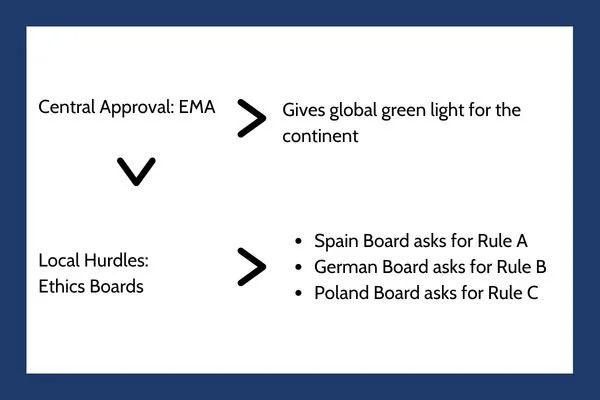
This is where true divergence shows its face. An ethics board in Germany might have a completely different requirement for patient data privacy compared to an ethics committee in Spain or Italy. One country might demand that patient consent forms be written in a highly specific linguistic style, while another might require extra blood tracking tests that the original master protocol did not include.
These local variations create a hidden labyrinth of review layers. If a pharmaceutical firm does not anticipate these regional differences, they will face sudden, cascading delays that can stall a global drug launch for months.
Navigating Local Intelligence and Change Management
Because local rules can vary so wildly, pharmaceutical companies are shifting how they plan their global operations. They are relying heavily on early local regulatory intelligence. This means that years before a drug is even ready for final approval, experts are on the ground in individual countries tracking the specific, unwritten preferences and shifting habits of regional boards.
To see how these international compliance standards are managed digitally across different regions, you can check the systems designed by PSC Software Compliance Systems. This type of specialized data tracking helps companies log changing regional requirements in real time, ensuring that an update made to a study protocol in one nation does not accidentally break a compliance rule in another.
Having local intelligence is only half the battle. A company must also possess effective change management systems. When an ethics committee in one country demands a sudden modification to a clinical trial or a manufacturing process, that change can trigger a massive chain reaction.
The company must update its laboratory records, notify packaging plants, alter digital labels, and inform clinical investigators worldwide. Without a rock solid change management strategy, a single localized request can cause a total operational breakdown across the entire global pipeline.
The Landscape of Drug Discovery Trends
As we advance through 2026, these regulatory shifts are fundamentally altering modern drug discovery trends. In the past, scientists would discover a molecule, test it in an isolated lab, and hand it off to a legal team to deal with compliance later. That old, disconnected model is no longer sustainable.
Today, regulatory strategy is baked directly into the earliest phases of scientific research. If a research team knows that Europe offers massive incentives for treating unmet medical needs, they will deliberately steer their laboratory focus toward rare, untreatable conditions.
Similarly, because supply chain tracking is now a strict legal requirement, discovery teams are choosing chemical ingredients that are easy and reliable to source globally, avoiding rare components that might trigger a supply chain alert later. The legal framework is actively shaping the molecular science of modern medicine.
Harmonization and Divergence in a Connected World
The ultimate goal for global health remains a world where a safe medicine can be developed once and deployed everywhere without unnecessary friction. Steps like the European pharma package prove that large-scale harmonization is possible, turning a collection of independent countries into a predictable, unified marketplace for healthcare innovation.
Yet, the persistence of local ethics boards, regional legal updates, and country-specific demands reminds us that complete uniformity is an illusion. True success in modern pharmaceuticals requires a delicate balance of macro and micro strategies.
Companies must design their master plans to align with sweeping global agreements, while keeping their operational teams agile enough to respect and adapt to local differences. By mastering this complex balancing act, the medical community can ensure that brilliant scientific discoveries do not get trapped in bureaucratic paperwork, but instead find their way into the hands of the patients who need them most.
Don't let the complex labyrinth of localized compliance, supply chain obligations, and shifting ethics board requirements stall your global drug launch. Contact Metis Consulting Services today