
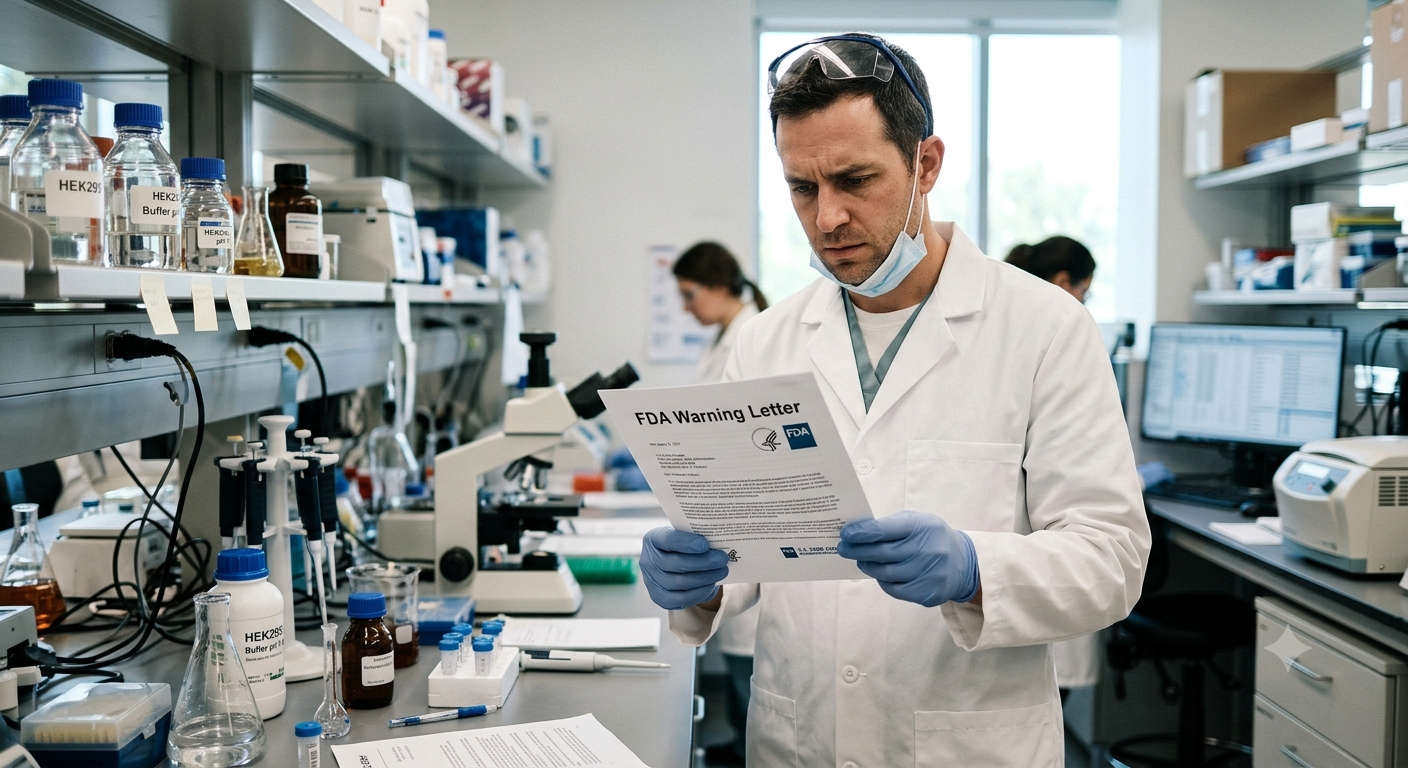
Outsourcing Oversight: FDA Form 483
Learn why maintaining rigorous third-party quality management is just as vital to your drug pipeline as the science itself. Read about why the critical operational risks highlighted in the FDA Form 483 Warning Letter are important to be aware of, and what dangerous oversight gaps exist in pharmaceutical outsourcing.
By Michael Bronfman
July 20, 2026
This week, discover why maintaining rigorous third-party quality management is just as vital to your drug pipeline as the science itself. Unpack with the "Guard Rail" the critical operational risks highlighted by FDA Form 483 citations and the dangerous oversight gaps in pharmaceutical outsourcing.
Imagine you are running a business that makes life-saving medicines. Because your business is growing fast, you decide to hire outside partners to manufacture the raw chemical ingredients, print the medical labels, and package the final pills. You sign the contracts, assuming these expert partners will handle everything perfectly.
Months later, an official investigator walks into your office and hands you a strict warning paper. The investigator found that your outside partner was using dirty equipment, and because you are the brand owner, your company is legally responsible.
This nightmare scenario happens constantly in the biotech world. The warning paper is called an FDA Form 483, which is the official document issued by investigators when they notice serious violations during factory visits.
A major blind spot in medicine manufacturing involves supplier quality management. Many biotech brands fail to realize that outsourcing production does not mean outsourcing legal liability. When a company fails to watch its external partners closely, it creates an oversight gap.
This gap frequently results in regulatory penalties, frozen pipelines, and missing medicines. Managing supplier risk is no longer just a minor paperwork requirement handled by a background department; it is a critical strategy needed to keep a pharmaceutical pipeline alive.
What is an FDA Form 483 and Why Does It Matter
To understand how this oversight gap happens, you have to understand how government monitoring works. The United States Food and Drug Administration conducts routine, unannounced physical inspections of factories where medicines are created. At the end of an inspection, if the investigator finds problems, they issue a Form 483 list of observations.
A Form 483 is not a final legal punishment, but it is a serious warning. If a business fails to fix the listed problems quickly, the situation can escalate into an official Warning Letter, which can shut down production entirely. You can read about the exact rules for these notices directly on the Inspection Observations Page of the FDA Website. This resource explains how field investigators evaluate factory conditions to ensure public safety.
In recent years, an increasing number of these forms point directly to poor supplier oversight. Government investigators are realizing that while biotech brands claim their products are pure, the brands rarely visit the third-party providers who supply the primary chemical components. This lack of visibility triggers immediate red flags during safety audits.
The Danger of Inadequate Supplier Qualification
The first place the oversight gap appears is during the initial hiring process, known as supplier qualification. Before a pharmaceutical firm buys a single gram of raw material from a third-party provider, they are required by law to run a deep background check on that supplier. This check ensures the provider follows current good manufacturing practices, which are the official quality rules for medicine creation.
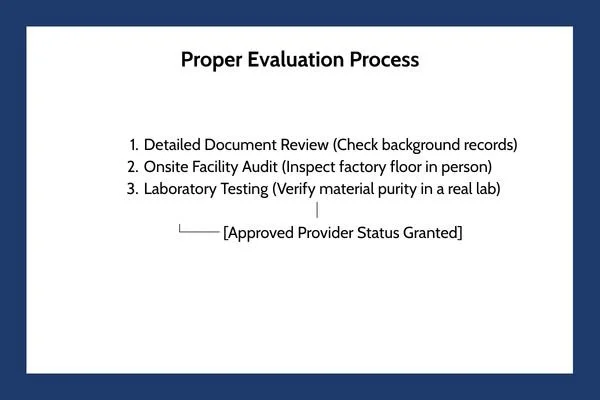
Too often, growing biotech firms take shortcuts during this stage. Instead of sending a trained inspector to physically walk through a provider's facility, a firm might simply send a basic text questionnaire through email. They ask the provider if their facilities are clean, the provider checks a box saying yes, and the firm grants them approved status.
This careless approach is called paper qualification, and it fails to satisfy modern regulators. A paper survey cannot spot broken air ventilation systems, leaking pipes, or untrained factory workers. When government inspectors find out that a pharmaceutical company approved a critical material provider based solely on an emailed questionnaire, they issue a severe citation on a Form 483.
Insufficient Oversight of Contract Manufacturers
As biotech companies discover complex new therapies, they rely heavily on specialized partners called Contract Development and Manufacturing Organizations. These partners act as hired factories, taking a drug design from a small startup and mass-producing it inside large industrial facilities.
While outsourcing production makes financial sense, it frequently causes a breakdown in quality control. The biotech brand often adopts a hands-off attitude, believing the hired manufacturer is entirely responsible for daily safety. This is a massive mistake. Under international health frameworks, the brand owner always retains ultimate responsibility for the purity of the drug.
The official global expectations for this relationship are outlined in detail within the FDA Guidance Document on the Q10 Pharmaceutical Quality System. This international framework states that a comprehensive quality management system must extend to the control and review of outsourced activities.
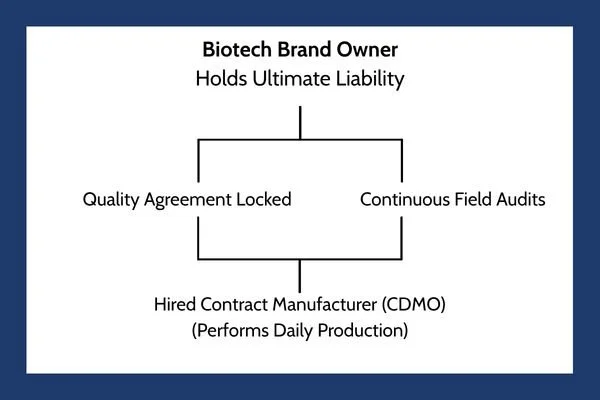
To eliminate the oversight gap, a biotech firm must treat their hired manufacturer as an extension of their own company. This integration requires:
Clear Quality Agreements: A legally binding document that states exactly which company handles specific testing steps, who approves batches, and how mistakes are corrected.
Continuous Person-in-Plant Oversight: Sending a full-time quality expert from the biotech brand to live at the hired manufacturer's facility, monitoring the production lines in person as your drug is made.
Shared Quality Data Tracking: Utilizing unified digital networks so the brand owner can review batch records, laboratory errors, and clean room data in real time, rather than waiting weeks for a text summary report.
The Hidden Risk of Incomplete Supplier Change Notifications
The third area where the oversight gap creates havoc involves supplier change notification processes. Medicine manufacturing is an incredibly delicate science. A microscopic shift in the raw materials can change how a drug behaves inside the human body, altering how fast a pill dissolves or causing unexpected allergic reactions.
Because the science is so sensitive, third-party providers are legally required to inform the biotech brand before making any modifications to their own facilities, raw materials, or testing tools. If a chemical supplier switches to a new raw material provider, or if a label printer updates their machine software, they must submit a formal change notification to the pharmaceutical brand owner.
Unfortunately, communication channels across these supply networks are often broken. A raw material provider might update a chemical purification tool, thinking the change is too minor to mention. If the pharmaceutical brand does not have a strict, mandatory system for tracking and forcing these updates, they remain completely unaware of the alteration.
When a government inspector reviews a biotech company's records and discovers that a raw chemical ingredient was altered without a formal evaluation, the factory receives an immediate Form 483 observation. The brand owner must prove they evaluated every single modification to ensure it did not alter the safety, identity, strength, quality, or purity of the distributed medicine.
Why Quality Management is a Major Pipeline Risk
When a pharmaceutical brand treats supplier oversight as an annoying checklist item rather than a core survival skill, they put their entire business pipeline at risk. The financial and operational damage caused by a single bad supplier can ruin years of scientific research.
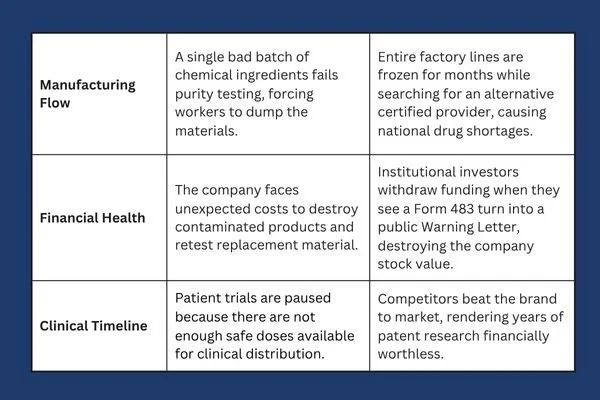
This table shows why supply chain monitoring is a critical commercial necessity. If your external partner fails a government inspection, your entire product launch can stall out, allowing rival businesses to capture the market.
Building a Modern Vendor Review Program
Fixing the oversight gap requires a complete shift in corporate mindset. Biotech organizations must stop choosing their partners based solely on the lowest price or the fastest timeline. Instead, they must construct an aggressive, data-driven vendor review program that treats safety as an active investment.
A modern vendor review strategy replaces casual trust with continuous verification. This process starts by ranking every partner based on risk. A vendor supplying the active chemical ingredient for an injection receives the highest risk rating and requires constant in-person monitoring and quarterly laboratory audits. A vendor supplying external cardboard shipping boxes receives a lower risk ranking, requiring fewer document checks.
Furthermore, companies must establish clear corrective and preventive action programs with their partners. If an external manufacturer makes a mistake, the biotech brand cannot simply accept a brief apology. The brand must force the partner to run a deep root cause analysis to discover why the error happened and prove that systemic changes were implemented to prevent the mistake from ever happening again.
Balancing Rapid Innovation with Supply Security
The biotech world is moving at a breathtaking pace, creating gene therapies and personalized medicines that were science fiction a decade ago. To bring these innovations to reality, companies must rely on a vast web of global suppliers. This interconnected network brings incredible strength, but it introduces immense vulnerability.
The persistent stream of Form 483 citations issued by health authorities is a clear warning that the industry is moving too fast for its own safety infrastructure. Designing an incredible molecule is meaningless if the third-party partner you hire to build it contaminates the batch with residue from a dirty machine.
As we look through 2026, the businesses that survive will be the ones that bridge the oversight gap completely. By treating supplier qualification, active partner communication, and strict change controls as vital priorities, biotech innovators protect their corporate reputation, satisfy tough regulators, and ensure a steady flow of safe therapies reaches the patients who depend on them.
Don't let your outsourcing strategy put your entire pipeline at risk: an unexpected FDA Form 483 or a partner's compliance oversight can derail years of clinical breakthroughs and market value. Contact Metis Consulting Services and establish an ironclad vendor review program, implement excellent quality agreements, and secure your global supply chain against regulatory friction.

GLP and GCP: How the FDA and EPA Watch Over Science
Two of the most important sets of rules are called GLP and GCP. In 2026, the two main government agencies responsible for these rules, the Food and Drug Administration (FDA) and the Environmental Protection Agency (EPA), are working together more than ever before. Re: FDA & EPA Oversight.

This week in the Guardrail…
We explore how federal oversight is shifting standards in 2026, making rigorous data integrity the new baseline for every laboratory and clinic.
By Michael Bronfman
The world of making new medicines and chemicals is a very busy place. Every day, scientists are working in labs and clinics to find the next big cure or a safer way to clean our homes. Because these products can affect our health and the planet, the government has very strict rules to ensure everything is done correctly. Two of the most important sets of rules are called GLP and GCP. In 2026, the two main government agencies responsible for these rules, the Food and Drug Administration (FDA) and the Environmental Protection Agency (EPA), are working together more than ever before. This “shaking out” of the rules is changing how companies operate.
What Do These Letters Mean
To understand the future of science, you first have to know what these abbreviations stand for. They are like a specialized language for safety and honesty.
GLP stands for Good Laboratory Practice. These rules are for the early stages of research. This is the work that happens in a lab with test tubes, plants, or animals before a human ever touches the product. The Environmental Protection Agency uses these rules to ensure that a new pesticide or powerful cleaner will not harm the environment or the people using it.
GCP stands for Good Clinical Practice. These rules start when the research moves into a clinic and involves human volunteers. The Food and Drug Administration uses GCP to ensure that participants in medical studies are safe and that the results are truthful.
The FDA and the EPA Joining Forces
In the past, these two agencies mostly stayed in their own separate worlds. If a company were making a heart medicine, they would talk to the FDA. If they were making a new bug spray, they would talk to the EPA. But today, many new products fall into both categories. For example, a special soap that kills germs on your skin might be considered both a medicine and a chemical.
Because of this, the FDA and EPA are now sharing their notes. If an EPA inspector finds that a lab is messy or that the scientists are not recording their results correctly, they report it to the FDA. This means companies can no longer be “half good.” They have to follow the rules perfectly for both agencies. This coordination ensures that, no matter what kind of product is being made, the public is protected by the highest standards.Official Federal Register : How these agencies work together
Why Honesty Is the Only Policy
The main goal of both GLP and GCP is to ensure data integrity. Data is just a fancy word for the information and results gathered during an experiment. If a scientist says that a drug worked on ten people, the government wants to see the actual signatures and blood test results to prove it.
If a company is caught lying about its data, it can be fined millions of dollars. They might even be banned from ever making products again. This is why risk management is so important during the middle stages of a study. If a company finds a minor mistake in its lab records, it needs to fix it immediately. Waiting until later to “clean up” the paperwork is a huge risk that can lead to a total failure when the FDA or EPA comes to visit.
Protecting the People in the Studies
While GLP protects the science in the lab, GCP protects the people in the clinics. Every person who joins a clinical trial is a volunteer. They are doing something brave to help others. GCP rules ensure that these volunteers are treated with respect.
Under these rules, every volunteer must sign a form acknowledging the risks. This is called informed consent. The doctors must also closely monitor the volunteers for any side effects. If a patient experiences a headache or dizziness, it must be recorded in the official files. TheNational Institutes of Health provides extensive information on how these rules help keep people safe in medical research.
The Quality Control Revolution
In 2026, many companies are hiring specialized teams just to ensure quality. These teams are like the “referees” of science. They do not do the experiments themselves. Instead, they monitor the other scientists to ensure they follow all GLP and GCP rules.
They check that lab machines are properly calibrated. They check to ensure that every signature on a form is genuine and dated correctly. This might sound like a lot of extra work, but it saves the company from failing an inspection. When a company has a high “quality score,” the FDA and EPA can trust their results much more easily. Organizations like theSociety of Quality Assurance help train these specialized workers to stay up to date on the latest rules.
Using Technology to Stay Safe
Technology is making it easier for the FDA and EPA to do their jobs. In the old days, inspectors had to look through thousands of paper files. Now, most of the data is digital. This allows the government to look at the data in real time.
If a lab in California runs a test, an official in Washington, D.C., can see the results almost instantly. This helps catch mistakes before they become big problems. It also makes it harder for anyone to change their results later to make a drug look better than it really is. This transparency is a big part of why the “shake out” between the two agencies is happening so fast. Digital tools make it impossible to hide in the shadows.
The Global Impact of These Rules
Australia, Europe, and the United States all have their own versions of these rules. However, they are all starting to look very similar. This is good news for the public. It means that a drug tested in Australia can be sold in America as long as it follows the same high standards of GLP and GCP.
When countries agree on the rules, medicines can travel around the world much faster. This helps people in every country get the help they need without waiting years for additional testing. TheWorld Health Organization works to help all countries follow these same high standards for health and safety.
Education Is the Key
For these rules to work, every person in the pharmaceutical industry needs to be educated. It is not just the boss's job. Even the person cleaning the lab or the nurse at the clinic needs to understand why the rules matter.
Education helps people understand that following the rules is about more than just avoiding a fine. It is about making sure that the medicine your grandmother takes, or the soap you use on your children, is 100 percent safe. When everyone knows the “why” behind the rules, they are much more likely to follow them correctly every single day.
Risk Management and Quality Systems
Modern pharmaceutical companies use a Quality Management System (QMS) to track everything. A QMS is like a giant digital brain that stores all the company's rules and records. It helps with risk handling by flagging errors the moment they happen.
In 2026, risk management strategies are no longer just about fixing problems. They are about predicting them. By using clinical data management tools, a biotech firm can detect whether a machine is starting to wear out or whether a lab is experiencing too many small errors. This type of risk management planning helps prevent major disasters that lead to FDA warning letters.
The Role of REMS in Safety
Another way the FDA keeps people safe is through REMS, which stands for Risk Evaluation and Mitigation Strategies. These are extra safety programs for drugs that might be dangerous if not used exactly right. For example, some medicines require a patient to get a blood test every month. TheFDA REMS website tracks these programs to ensure drug companies are doing their part to manage risk.
Final Thoughts on the Future of Quality
The “shaking out” of rules between the FDA and the EPA is a positive step for everyone. It means that science is becoming more open and more honest. Companies are learning that they cannot take shortcuts during any stage of research.
By following the rules of GLP and GCP, we ensure that the future of medicine is bright. We can trust the products we buy because we know the government is watching and the scientists are being careful. Quality is not just a set of letters; it is a promise to the public that their safety is the most important thing of all. Don’t wait for a problem to appear before you start being careful. Start with quality on day one and the rest of the journey will be much smoother for everyone.
Frequently Asked Questions: GLP, GCP, and Regulatory Compliance
What is the main difference between GLP and GCP?The biggest difference is when they are used. GLP is for the preclinical stage, which is work done in a lab on animals or cells. GCP is for the clinical stage involving human volunteers.
Why does the EPA care about laboratory rules?The EPA ensures that chemicals like weed killers do not pollute our water. They use GLP to ensure companies are honest about chemical safety. You can find guidelines on theEPA Compliance Monitoring page.
Can a company fail a trial if they follow the science but miss the paperwork?Yes. In the eyes of the FDA, if a test was not documented correctly, it never happened. “Clean data” is just as important as the medicine itself.
What happens during an FDA or EPA inspection?Inspectors check original notebooks, computer logs, and even equipment logs. They want to see a clear trail from the study's start to the final report.
How does Risk Mitigation help with these rules?It means finding small mistakes before the government does. Fixing a mistake early in a study costs much less than fixing it later, when thousands of people are involved.
Where can I stay updated on these changing rules in 2026?The best place to watch for updates is theFDA Voice blog. This site tracks how the agencies are joining their rules for digital data. https://www.fda.gov/news-events/fda-newsroom/fda-voices.
The Pre-Inspection Compliance Checklist
When an inspector arrives, they look for a “culture of quality.” If you are preparing for an audit in 2026, here are the top ten things you must have ready.
Item
Description
1. The Master Schedule
A list of every study that has happened in your lab.
2. Current SOPs
Proof that your team is using the newest versions of your rulebooks.
3. Training Logs
Proof that every person was taught how to do their job before starting.
4. Equipment Records
Logs showing that every scale and fridge is checked regularly.
5. Chain of Custody
A record of who touched a sample at every single minute.
6. Raw Data
Original handwritten notes or machine printouts.
7. QA Reports
Reports from your own internal “referees.”
8. CAPA Plans
Records showing how you found and fixed past mistakes.
9. Computer Validation
Proof that your digital data is secure and cannot be changed.
10. Signatures and Dates
Every page must be signed with no blank spaces or whiteout used.
Final Tip: The Clean Room Rule
An inspector will also look at your physical space. If a lab is cluttered, they will assume the data is also messy. A clean and organized lab tells the inspector that you take quality management seriously. For more help, you can check the FDA Inspection Guide for the latest standards.
Secure Your Future in Science with Metis Consulting Services
When "good enough" no longer passes the test, your organization needs to turn regulatory pressure into a competitive advantage. Contact Metis Consulting Services today to ensure your next breakthrough is backed by an unbreakable foundation of compliance.

Disruption to Delivery: How to Ease the Burdens While Raising the Quality Assurance Expectations

For Metis Consulting Services
By Michael Bronfman
September 8, 2025
Welcome to this week at the Guard Rail! Global events are constantly challenging the supply chain in our industry, the pharmaceutical space faces a unique tightrope walk. At Metis, we understand the dual pressures of getting vital therapies to patients quickly while ensuring every single product meets the highest safety standards. This article dives into how companies can find the sweet spot, protecting both public health and their business without overwhelming their teams.
The pharmaceutical industry stands at a complex crossroads. Companies face constant pressure to deliver new therapies faster while meeting strict safety standards. At the same time, global supply chains remain vulnerable to disruption, and regulatory agencies continue to raise expectations for quality assurance.
These trends create a heavy burden for manufacturers, distributors, and quality teams. The challenge is to ease that burden without lowering the standards that protect patients.
This article will explore the causes of delivery disruptions in the pharmaceutical sector, the growing expectations for quality assurance, and the strategies that companies can adopt to balance both sides. The goal is to show how organizations can protect patient access to medicine while ensuring that every product meets the highest possible quality standards.
The Nature of Delivery Disruption
Delivery disruption can take many forms. Global events, such as pandemics, have shown how quickly supply chains can break down. Political conflicts and trade restrictions also place limits on the movement of raw materials. Even natural disasters, such as floods or earthquakes, can create sudden shortages.
Disruption can also arise from within the industry itself. Complex manufacturing processes can lead to delays when equipment breaks down or when staff shortages occur. Quality concerns that require additional testing may slow down production lines. If regulators identify concerns during inspections, companies may need to halt shipments until corrective actions are complete.
In the pharmaceutical space, these disruptions carry higher stakes than in most industries. Patients rely on timely access to treatments. Delays in delivery can worsen disease outcomes or reduce trust in the health care system. For companies, disruption leads not only to lost revenue but also to reputational damage that can last for years.
Rising Expectations for Quality Assurance
While supply chain risks grow, regulators and patients expect higher levels of safety and reliability. Quality assurance is no longer seen as a supporting function but as a central pillar of the pharmaceutical business. Agencies around the world demand more rigorous documentation, more transparent data, and stronger monitoring across the product life cycle.
Quality assurance today extends far beyond the factory floor. It includes supplier audits, shipping controls, temperature monitoring, serialization, and post-market surveillance. A single misstep at any point can trigger recalls, fines, or loss of license.
The paradox is clear. Companies must deliver faster and more reliably, while also meeting more demanding quality requirements. The result is pressure on staff, systems, and budgets. This is why new approaches are necessary to ease the burdens without lowering the bar.
The Burden on Organizations
When disruption meets higher quality expectations, the result is strain across the enterprise. Manufacturing staff must work longer hours to keep up with delays. Quality professionals must review more data and more reports than ever before. Regulatory affairs teams must stay updated with complex, often changing rules across many countries.
The burden extends to suppliers as well. Raw material providers must show compliance with strict guidelines. Distributors must track conditions during shipping. Even pharmacies and hospitals must store products according to strict requirements, which can be difficult in resource limited settings.
Financial pressure adds to this burden. Every additional quality measure costs money. Extra testing, additional audits, or investment in monitoring technology all increase expenses. Companies must balance these costs against the pressure to make medicines affordable.
Easing the Burdens without Lowering Standards
The question for industry leaders is how to reduce stress on staff and systems while still meeting the rising expectations. Several approaches can help.
1. Building Resilient Supply Chains
Resilience begins with diversity. Companies should avoid relying on a single supplier or a single geographic region for key ingredients. Multiple qualified suppliers can reduce the risk of shortages. Local or regional sourcing, where possible, can reduce exposure to global shipping delays.
Resilience also requires stronger collaboration. Sharing information with suppliers, distributors, and regulators can prevent small issues from turning into major disruptions. Transparency about challenges builds trust and allows all parties to prepare together.
2. Investing in Workforce Development
Staff members remain the most important resource for quality assurance. Companies must invest in training programs that build both technical skills and problem-solving skills. A workforce that understands quality requirements can catch errors early, reducing delays later.
Support for employee well-being also matters. Long hours and constant pressure lead to fatigue, which in turn can create mistakes. Providing balanced schedules, clear communication, and mental health resources helps staff remain engaged and careful.
3. Streamlining Processes
Many burdens arise from complex and outdated processes. Streamlining workflows can remove unnecessary steps while keeping compliance intact. Clear documentation, standardized procedures, and better alignment between departments reduce duplication and confusion.
Process mapping can reveal where bottlenecks occur. Once identified, leaders can simplify approval chains or adjust schedules to prevent repeated delays. Streamlining does not mean cutting corners. It means working smarter to reach the same quality outcomes with less wasted effort.
4. Enhancing Monitoring and Transparency
Disruptions are easier to manage when detected early. Strong monitoring of supply chains, production lines, and shipping conditions provides early warning signs. With timely data, companies can respond before issues escalate.
Transparency is the key. By sharing monitoring data openly, companies show accountability. This can reduce the number of surprise inspections and create a more cooperative and trustworthy relationship with oversight agencies.
5. Encouraging Cross-Functional Collaboration
Quality assurance does not belong to one department. Manufacturing, supply chain, regulatory affairs, and commercial teams all play a role. Cross-functional collaboration ensures that quality standards are considered at every stage.
When departments work together, they can share resources, identify risks earlier, and support one another during disruptions. This culture of shared responsibility lightens the load on any single group while raising the overall standard.
The Role of Technology
Although new tools can feel like an added expense, they often reduce the burden in the long run. Digital monitoring systems can track temperature and humidity during shipping with greater accuracy than manual methods. Cloud-based platforms allow global teams to share documents in real time, reducing the delays caused by communication gaps.
Automation in manufacturing can improve consistency, reduce errors, and free staff from repetitive tasks. Predictive analytics can help forecast supply needs, reducing the risk of sudden shortages. These technologies do not replace the need for human oversight but rather support staff in meeting higher expectations more efficiently.
Case Study: Managing a Major Disruption
To illustrate the balance between easing burdens and maintaining quality, consider a company that relies on a single supplier for a critical raw material. When political conflict disrupts trade, the supplier can no longer ship the material. Production halts, and patients face the risk of delays in receiving treatment.
A company that has built resilience would have pre-qualified a second supplier in another region. Quality assurance teams would already have reviewed the supplier’s processes, ensuring compliance with all standards. With this preparation, the company can switch suppliers quickly, avoiding a major disruption.
At the same time, the company maintains transparent communication with regulators and health care providers. By explaining the switch, sharing data about supplier compliance, and monitoring product performance closely, the company both eases the burden of crisis management and raises the standard of accountability.
Preparing for the Future
The pressure on pharmaceutical companies will not decrease. Global events will continue to disrupt supply chains, and regulators will continue to raise expectations. The companies that succeed will be those that prepare now.
Future readiness requires long-term planning. Leaders must see beyond immediate cost savings and recognize the value of resilience and quality. The investment made today in training, monitoring, and supplier diversity will pay off when the next disruption arrives.
It also requires a cultural shift. Quality must be seen not as a cost but as a value. It protects patients, strengthens reputations, and builds trust. By making quality a shared responsibility across the organization, companies can meet higher expectations with less individual strain.
Disruption to delivery is inevitable in the modern pharmaceutical landscape. Rising expectations for quality assurance make the challenge even greater. Yet companies need not choose between burden and safety. Through resilient supply chains, workforce investment, streamlined processes, enhanced monitoring, collaboration, and thoughtful use of technology, it is possible to ease the load while raising standards.
The future of pharmaceutical delivery depends on this balance. Patients deserve both timely access and reliable quality. Companies that find ways to reduce the burdens while maintaining strict assurance will protect both public health and their own long-term success.
The pharmaceutical industry will continue to face disruptions and rising expectations. The time to prepare is now. Don't let the dual pressures of delivery and quality assurance compromise your mission or strain your team. At Metis, we will collaborate with you to build the resilient systems and streamlined processes necessary to thrive in this complex environment. Let's start a conversation about how we can help you turn disruption into an opportunity for excellence. Reach out to us at hello@metisconsultingservices.com and take the first step toward a more resilient future.