

Discover how forward-thinking life sciences leaders are turning shrinking public training subsidies into a competitive advantage this week in the Guardrail. The most resilient pharmaceutical executives are taking direct ownership of workforce development—and seeing immediate returns in floor readiness and retention.
By Michael Bronfman
November 23, 2026
The pharmaceutical industry’s old talent model is hitting a wall. For years, drug makers and biotech firms leaned heavily on public grants, federal training funds, and state-backed education pipelines to bring new workers into labs and cleanrooms. Today, those public safety nets are shrinking. Government budgets are tighter, grant pools are smaller, and competition for public money is fiercer than ever. At the exact same time, the demand for skilled workers in medicine production, quality control, and clinical research is climbing fast.
Waiting around for state agencies to fix the talent shortage is not a workable plan. When public support slips away, pharmaceutical leaders have to step in. Building a capable, steady workforce now means creating private pipelines, rethinking how we hire, and investing directly in people from the ground up. Let’s look at a practical roadmap for how life sciences companies can close the skills gap on their own terms.
Why the Old Hiring Playbook Is Broken
For decades, pharmaceutical recruiting followed a strict, predictable formula. Companies posted job listings that demanded four-year biology or chemistry degrees, plus several years of direct industry experience. They waited for universities to produce graduates, and they counted on government workforce programs to pay for basic job=readiness training.
That model is falling apart for three simple reasons.
First, there are simply not enough science graduates coming out of traditional four-year colleges to fill open seats on the manufacturing floor. Modern biologics, cell therapies, and personalized medicines require hands-on technical skills that a standard university lecture hall rarely teaches.
Second, public funding programs like the Workforce Innovation and Opportunity Act face heavy demand across dozens of competing industries. While federal and state grants still exist, relying on them as your primary hiring engine leaves your production schedule at the mercy of slow bureaucracy and shifting political budgets.
Third, poaching experienced talent from rival drug makers is a losing game. Trading the same small pool of senior technicians back and forth drives up payroll costs without adding a single new skilled worker to the industry. To survive and grow, companies must stop fishing in the same tiny pond and start building new ones.
Shift From Degree Requirements to Skills-Based Hiring
One of the fastest, cheapest ways to expand your talent pool is to rewrite your job descriptions. Many roles in pharmaceutical manufacturing, packaging, warehouse logistics, and quality assurance do not actually require a four-year bachelor's degree. Yet countless companies still list a college degree as a hard barrier just out of habit.
When you drop unnecessary degree rules and focus on real abilities, thousands of capable candidates suddenly appear. Consider workers from adjacent fields. Food and beverage manufacturing, semiconductor fabrication, aerospace assembly, and military service all demand strict safety habits, clean environments, and exact compliance with written rules. A veteran who maintained jet engines or a technician who ran sterile bottling lines already understands why following a checklist matters.
Industry analysts at Pharmaceutical Executive point out that hiring for transferable traits like problem-solving, attention to detail, and teamwork allows companies to fill critical gaps much faster. Instead of screening resumes for a specific diploma, use practical skills tests and structured interviews to see how candidates think on their feet. You can teach a sharp, reliable person how to follow Good Manufacturing Practices in a few months. Teaching someone work ethic and focus is much harder.
Build Private Apprenticeships That Pay for Themselves
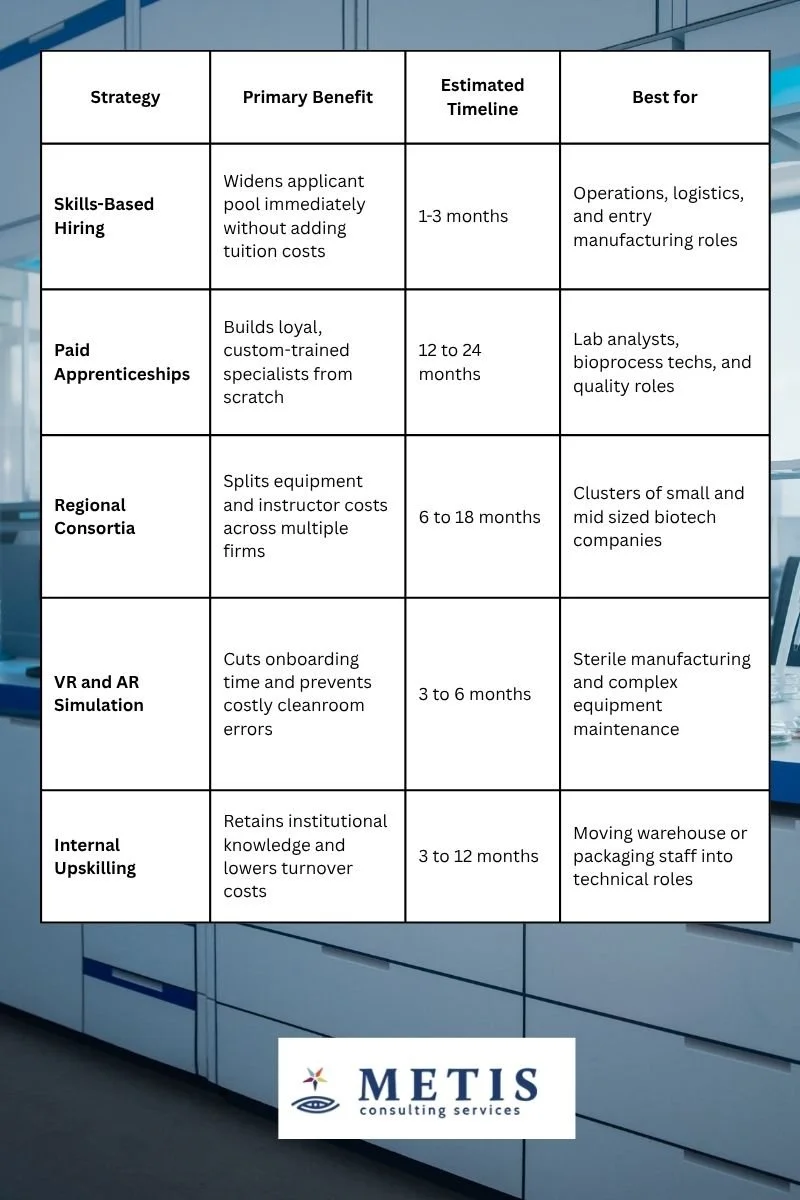
If public schools and government grants are not delivering skilled workers, companies can train their own through paid apprenticeships. Apprenticeships combine paid, on-the-job floor training with targeted classroom teaching. Instead of paying high recruiting fees or watching batches fail due to rookie mistakes, firms invest that money directly into forging their own workforce.
Major players are already proving this works.1 Some run structured apprenticeships that pair full-time paid work with company-funded college tuition toward an associate degree. Others partner directly with local community colleges to give high school graduates a debt-free path into biomanufacturing while earning a steady paycheck from day one.2
Small and mid-sized drug makers do not need massive corporate budgets to copy this model. You can start small with a cohort of five or ten apprentices:
Map out your hardest-to-fill entry roles, such as cleanroom operators, pharmacy technicians, or quality control samplers.
Partner with a local community college or technical school to handle basic science and math classes while your senior staff teaches the hands-on lab work.
Create clear wage steps: apprentices will see their pay rise as they master new machines and pass safety checks.
Pair every newcomer with a seasoned mentor on the floor to answer questions and build confidence during their first year.
Apprenticeships also solve a huge hidden cost in pharma: turnover. Workers who earn a credential and a career path without taking on student debt tend to stay loyal to the company that gave them their start.
Form Regional Industry Consortia to Share Training Costs
Going it alone without government money can feel overwhelming for a single facility. The smartest way to lower the financial burden is to team up with neighboring companies, even competitors, to share training infrastructure.
Across the country, industry groups are pooling their resources to build shared training centers. Organizations like the National Institute for Innovation in Manufacturing Biopharmaceuticals bring together drug makers, equipment suppliers, and educators to build standardized training courses and hands-on workshops. When ten regional companies chip in to fund a shared cleanroom training lab at a local technical college, everybody wins. No single company bears the full price tag, and every firm gets access to graduates who already know how to gown up, run bioreactors, and log batch records.
Look also at regional models like the Wistar Institute Quality Science Pathway Apprenticeship, where local life sciences employers help write the exact curriculum taught to students. When industry leaders sit at the table with educators, schools stop teaching outdated theory and start teaching the exact software, testing methods, and safety rules used on modern production lines.
Use Modern Tech to Cut Training Time and Waste
Traditional pharmaceutical training is slow, expensive, and risky. Putting a brand new hire inside a live sterile suite to practice mixing ingredients carries a massive risk of batch contamination or ruined equipment. At the same time, reading thick binders of standard operating procedures for six weeks bores new hires to tears and leaves them unprepared for real pressure.
Digital simulation tools are changing that equation. Virtual reality and augmented reality headsets let trainees walk through a digital twin of your exact manufacturing floor before they ever touch a real valve or vial. Industry reporting from Pharmaphorum highlights how immersive simulations allow staff to practice complex sterile procedures safely, catching mistakes in a virtual room where errors cost zero dollars.
Augmented reality glasses can also guide workers step by step during live maintenance or line changeovers, displaying checklists right in their line of sight. This technology shortens onboarding time from months to weeks, reduces human error, and lets your senior engineers focus on high-level problem-solving rather than babysitting trainees.
Upskill Your Current Workforce From Within
Often, the best future leaders and senior technicians are already on your payroll. When external hiring gets tough and public training subsidies dry up, looking inward is your strongest move.
Many entry-level workers in packaging, sanitation, or warehouse operations have the intelligence and drive to become lab analysts or manufacturing leads, yet they lack a clear ladder to climb. Building internal career pathways keeps institutional knowledge inside your walls and boosts morale across the entire plant.
Start by auditing the hidden talents of your current staff. Offer paid study hours, micro-credentials, and cross-training rotations. For example, a pharmacy support worker can study for national credentials through programs outlined by the Pharmacy Technician Certification Board while continuing to earn their regular wages. Training providers3 note that employer-sponsored certification programs dramatically improve retention because workers see a real future with their employer.
Start by auditing the hidden talents of your current staff. Offer paid study hours, micro-credentials, and cross-training rotations. For example, a pharmacy support worker can study for national credentials through programs outlined by the Pharmacy Technician Certification Board while continuing to earn their regular wages. Training providers 3. note that employer-sponsored certification programs dramatically improve retention because workers see a real future with their employer.
Reach Students Before They Choose Another Career
One quiet reason for the pharma talent crunch is a lack of awareness. Most high school and early college students have no idea what biomanufacturing actually looks like. They picture scientists in white coats staring through microscopes for ten years, not realizing that modern drug plants can be high-tech, clean, well-paid environments full of robotics, data analytics, and teamwork.
When public outreach campaigns slow down, pharma companies must tell their own story in local schools. Hosting plant tours, sponsoring high school science clubs, and offering paid summer internships for freshmen and sophomores plant seeds that pay off three or four years later.
Programs like the NIIMBL eXperience show how one week of hands-on exposure to state-of-the-art equipment and real industry mentors can convince young college students to pursue biopharma careers instead of defaulting to tech or finance. Even inviting local high school science teachers to tour your facility for a single day turns them into informed ambassadors who can guide dozens of students to your doors every year.
Taking Ownership of the Future Workforce
As public support pulls back, the pharmaceutical companies that thrive will treat talent development like research and development: a core business investment rather than an optional expense.
By dropping rigid degree barriers, launching practical apprenticeships, sharing training labs with regional peers, and adopting virtual simulation tools, biotech leaders can build a resilient, homegrown workforce. The talent is out there. When the industry takes charge of training it, patients get their medicines on time, and workers gain lifelong careers that aren’t dependent on the vagaries of public funding. And no government budget cuts can take those away.
Building a self-sufficient talent pipeline requires more than a change in mindset. Let us help you. Don't let public funding cuts slow your production schedule; contact Metis Consulting Services today.
Resources:
