
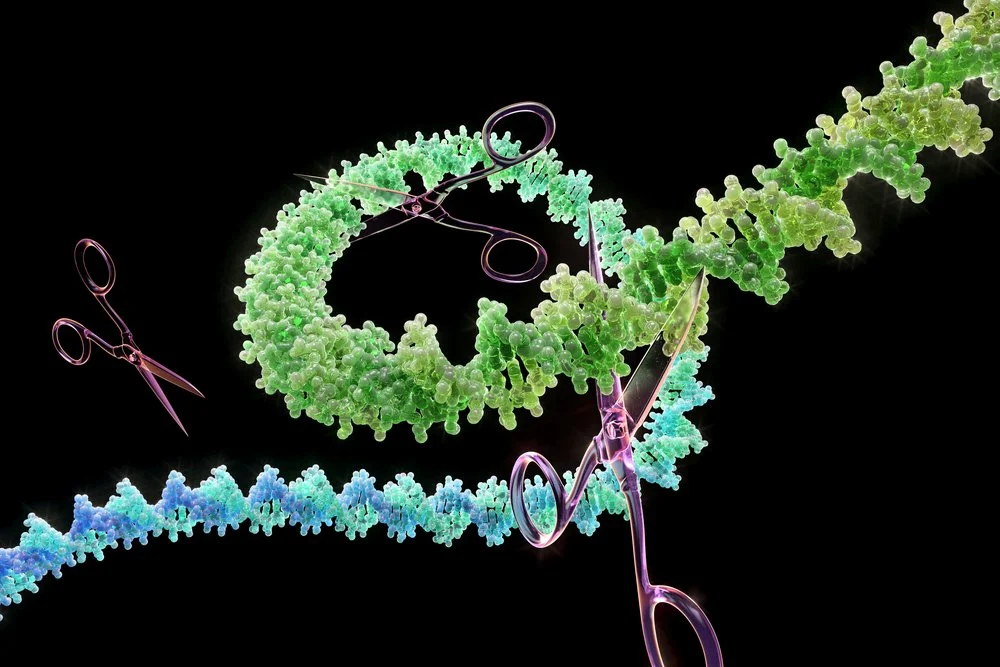
Epigenome editing is moving precision medicine beyond traditional molecular "scissors" by controlling gene expression without ever cutting a single strand of DNA. This week in the Guardrail, discover how turning genes up, down, or completely silent offers a safer, potentially reversible path to treating complex and chronic diseases.
By Michael Bronfman
November 16, 2026
The human body is made of trillions of tiny cells, and inside almost every single cell sits a master instruction book called DNA. For decades, scientists believed that our health was strictly determined by the exact letters written on those pages. If an error or mutation existed in that content, a person might develop a severe illness. To cure the disease, you had to physically alter the text.
In recent years, breakthroughs like CRISPR gene editing have given doctors the ability to find a flawed sentence in our genetic code and slice it out. While that breakthrough was celebrated across the globe, cutting into the human genome can sometimes cause lasting problems. Is there a way to fix the problem without ever cutting the DNA? What if you did not need to erase a single letter, but could simply tell the cell whether to read or ignore that page?
This is why epigenome editing is such an exciting breakthrough. It represents a massive step forward in biotechnology. Instead of using microscopic “scissors“ to cut and paste DNA sequences, scientists can place small chemical tags onto the genetic code. They turn specific genes up, down, or completely silent without touching the underlying sequence.
The Problem With Molecular “Scissors”
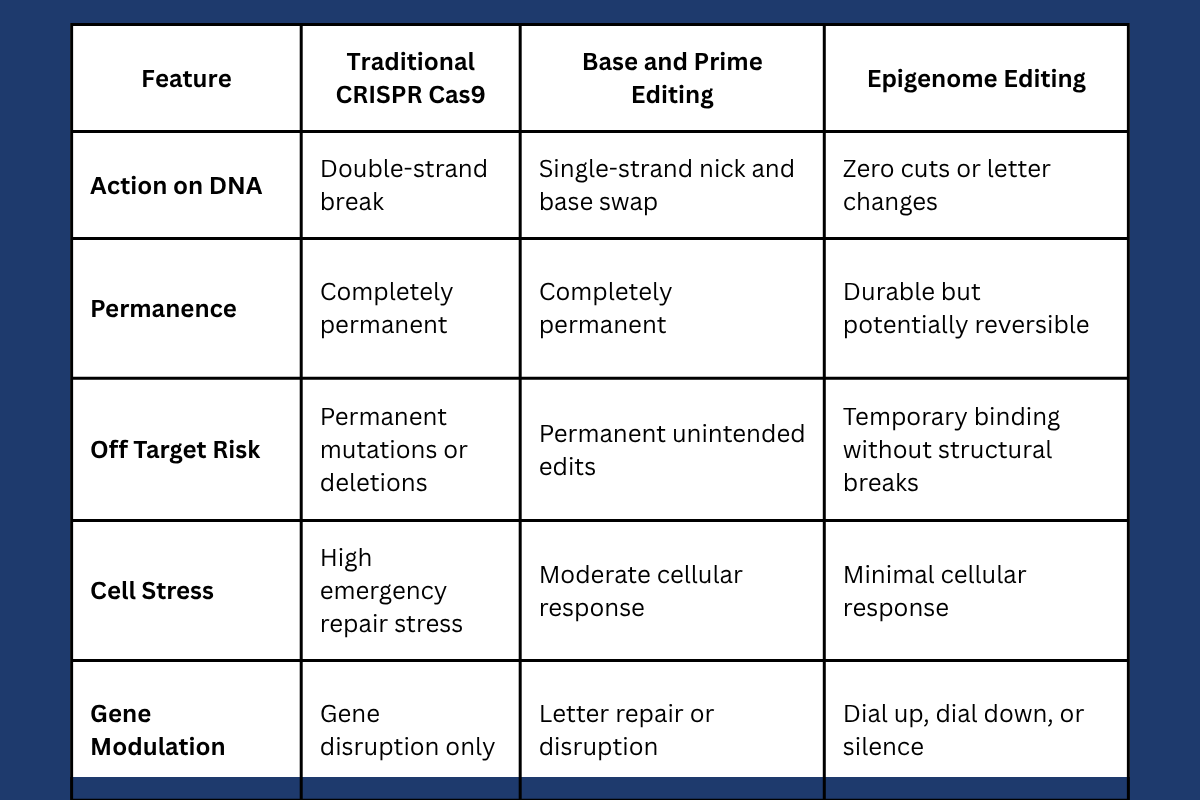
To understand why epigenome editing is so exciting, it helps to look at the tools that came before it. The most famous gene editing tool is CRISPR Cas9. It was adapted from natural defense systems that bacteria use to destroy invading viruses. The system acts like a molecular GPS paired with molecular scissors. A small guide molecule leads an enzyme directly to an exact spot in the DNA. Once there, the enzyme cuts through both strands of the DNA ladder.
When that double-strand break happens, the cell rushes to repair the damage. Often, the repair job is messy, which can disable a faulty gene. Later advances brought base editing and prime editing. Base editing swaps out single chemical letters without breaking the entire double strand. Prime editing functions like a word processor “search and replace “ feature.
While these tools are remarkable feats of science, they carry intrinsic risks. Any time an enzyme breaks or rewrites the actual DNA sequence, that change is permanent. Once the edit happens, you cannot undo it. If the “scissors” make an accidental cut at the wrong address in the genome, an error known as an off-target effect, it can result in dangerous side effects, even cancer.
Doctor Fyodor Urnov, a pioneer in gene editing at the University of California Berkeley, has often noted that altering the sequence of human DNA forever is a heavy responsibility which requires caution. When doctors cut the genome, they are making a permanent wager that nothing else in the cell was harmed. Epigenome editing is designed to remove that risk.
Reading The Sticky Notes Of Life
If your DNA sequence is the physical paper and ink of an instruction book, the epigenome is the collection of sticky notes, paper clips, and highlighter marks placed over the pages. The word epigenetics comes from the Greek prefix epi, meaning above or on top of.
The biological reality is that every cell in your body has the exact same DNA sequence. Your eye cells, heart cells, skin cells, and liver cells share an identical book of instructions. Yet, a heart cell behaves completely differently from a skin cell. Why? Because each cell type uses epigenetic marks to silence the instructions it does not need and highlight the ones it must use every day.
Scientists study two main types of natural epigenetic marks:
DNA Methylation: Small chemical tags called methyl groups attach directly onto the surface of certain DNA letters. When a cluster of these tags settles on the promoter region at the start of a gene, it acts like a locked gate. Cellular reading machinery cannot latch onto the gene, and the gene remains turned off.
Histone Modification: Inside the nucleus, long strands of DNA are wound tightly around spool-shaped proteins called histones. If the spools are packed together like a tightly coiled spring, the cell cannot get inside to read the text. If the cell adds chemical tags like acetyl groups to the histones, the coils loosen up, giving reading machines full access to run off copies of the gene.
Doctor Rudolf Jaenisch, a founding scientist at the Whitehead Institute for Biomedical Research, demonstrated decades ago that the epigenetic marks dictate cell identity and disease progression without changing the underlying genetic sequence. The promise of epigenome editing is simple: take those natural volume knobs and light switches, attach them to a targeted navigation system, and tell disease-causing genes exactly how to behave.
How Epigenome Editing Works
Epigenome editing tools borrow the navigation power of CRISPR, but they remove the cutting blade. Researchers engineer a deactivated version of the Cas enzyme, often called dead Cas or dCas. This modified protein still follows a guide RNA to find a single target out of billions of letters in the genome. However, because its cutting machinery is turned off, it sits peacefully on the DNA without snipping the strand.
Scientists then fuse that deactivated protein to an epigenetic engine, often referred to as an effector domain.
If a doctor wants to turn off a gene that produces a toxic protein, they attach an enzyme called a methyltransferase to the deactivated guide. When the guide parks at the gene, the enzyme deposits methyl tags across the promoter. The gene shuts down quietly.
Conversely, if a patient suffers from a condition where a healthy gene is trapped in a dormant state, doctors can send in a dead Cas paired with a demethylase or a histone opener. The tool sweeps away the silencing tags, untangles the DNA spools, and prompts the cell to turn the beneficial gene back on.
Doctor Angelo Lombardo and Doctor Luigi Naldini at the San Raffaele Telethon Institute for Gene Therapy conducted early proof-of-concept experiments proving that targeted methylation could turn off specific genes in living cells. Their work showed that cells could inherit these muted settings through multiple cell divisions, meaning a single treatment could provide long-lasting therapeutic benefit.
Primary Advantages: Reversibility & Safety
Why are pharmaceutical companies investing hundreds of millions of dollars into this technology? The excitement rests on three chief advantages:
No Permanent Structural Changes
Because the DNA backbone is never broken, the cell does not undergo the emergency stress responses induced by standard CRISPR cuts. There is virtually no risk of accidental chromosomal rearrangements, large deletions, or translocations, where pieces of two different chromosomes accidentally fuse together.
Lower Consequences For Off-Target Binding
Even if an epigenetic editor temporarily binds to the wrong region of the genome, it does not permanently break or alter that foreign site. Furthermore, placing an epigenetic tag on a gene does not automatically change its behavior unless the mark is placed in the exact regulatory promoter window. This gives the therapy an extra layer of natural safety.
Potential Reversibility
Permanent genetic cuts are irreversible. Epigenetic marks, on the other hand, are designed by nature to be dynamic. If a patient experiences an unforeseen reaction, or if clinical needs change, doctors could theoretically administer an opposing epigenetic editor to remove the chemical tags and restore the gene to its original state.
The Commercial Race: nChroma Bio And Industry Leaders
The biotechnology world has taken notice of these advantages. Several innovative companies are moving epigenetic platforms from academic laboratories into commercial drug development pipelines.1
At first the platforms focused on engineered epigenetic editors that can deposit multiple methylation marks at once to lock down disease genes permanently across cell divisions. However, building the genetic drug is only half the battle. You also have to deliver it into the human body safely. By combining epigenetic editor design with targeted non-viral delivery vehicles, an integrated platform was designed to transport complex epigenetic payloads directly to target organs like the liver without viruses.
Other biotechs are pursuing similar goals:
Real World Targets In Medicine
Where will patients see the benefits of epigenome editing first?
High Cholesterol And Heart Disease
One of the most imminent applications is controlling blood cholesterol levels. Some people produce excessive levels of a protein called PCSK9, which destroys the receptors that clear bad cholesterol from the bloodstream. Several groups have demonstrated in animal models that placing an epigenetic silencing mark on the PCSK9 gene permanently lowers cholesterol levels without requiring a single cut to the DNA. A single treatment could replace a lifetime of daily pills or monthly injections.
Chronic Viral Infections
Viruses like Hepatitis B insert their genetic material into liver cells and hide there for decades. Standard antiviral medications can suppress the virus, but they rarely eliminate this dormant viral reservoir. Epigenome editing tools can be sent directly into the infected cells to attach silencing tags to the viral DNA itself, rendering the virus completely inert and harmless.
Complex And Polygenic Diseases
Most human ailments, such as type 2 diabetes, autoimmune disorders, and chronic kidney disease, are not caused by a single broken letter in one gene. They are caused by networks of dozens of genes working out of balance. Traditional CRISPR cannot safely cut forty different sites across the genome at once; doing so would break the chromosomes. Epigenome editing platforms, however, can multiplex. They can distribute regulatory tags across dozens of genes simultaneously without breaking a single strand of DNA.
Remaining Hurdles On The Road To The Clinic
Despite its enormous potential, epigenome editing still faces major technical challenges before it becomes a standard part of hospital pharmacy shelves.
The first obstacle is epigenetic durability. When a cell divides, it makes a copy of its DNA and attempts to copy its epigenetic tags as well. While natural methylation patterns are copied reliably, synthetic tags placed by artificial tools can sometimes be stripped away by the cell over weeks or months. Researchers are currently engineering combo editors that add multiple layers of chromatin marks to ensure the silent state lasts for decades.
The second obstacle is delivery. Epigenetic editor complexes tend to be large because they combine a guide system, a deactivated protein, and an effector enzyme. Packaging these large instructions into safe delivery vehicles like lipid nanoparticles remains an active engineering challenge.
Doctor Kiran Musunuru, a cardiologist and gene editing specialist at the University of Pennsylvania, regularly emphasizes that solving in vivo delivery is the grand challenge for all next-generation genetic therapies. If the package cannot reach the correct organ, even the most elegant molecular tool cannot heal the patient.
The third obstacle involves regulatory pathways. Because epigenome editing is an entirely new category of medicine, health authorities like the United States Food and Drug Administration are working alongside scientists to establish safety testing protocols. Regulators must determine how long treated patients must be tracked to confirm that epigenetic modifications do not drift or reverse unexpectedly over time.
The Dawn Of Genomic Software Control
Medical science is undergoing a profound philosophical shift. For the last ten years, the genetic medicine community operated like hardware technicians, opening up the biological casing and using physical tools to slice, cut, and solder the physical wiring of DNA.
Epigenome editing shifts the approach from hardware repair to software programming. The underlying hard drive sequence is pristine, untouched, and intact. Instead, doctors can alter the biological operating code, turning volume knobs up or down and telling the body how to heal itself.2
As academic leaders and commercial organizations like nChroma Bio Tune Therapeutics, Epic Bio, and Sangamo Therapeutics move these tools toward human clinical trials, the promise of precision medicine grows brighter. By giving doctors the ability to control gene expression safely, precisely, and reversibly, epigenome editing stands ready to change how we treat chronic illness, genetic conditions, and the basic mechanisms of human disease.3,4 Whether your team is building scalable quality systems, preparing for clinical trials, or establishing pharmacovigilance frameworks for novel modalities, Metis Consulting Services is ready to help
