
Personalized Gene Editing: The Successful Treatment of "Baby KJ”
This week in the Guardrail, a remarkable medical triumph is quietly reshaping what we thought was possible. Step inside the emerging frontier where individualized medicine is rewriting the rules of healthcare—one patient at a time.
By Michael Bronfman
September 28, 2026
Every individual carries a unique genetic code made of over three billion DNA base pairs. When even a single letter in that immense sequence is mismatched, the consequences can be devastating. For generations, medicine had no way to fix these fundamental errors. Doctors could only treat the symptoms while rare genetic conditions progressed without a cure. Today, that reality is changing rapidly. The arrival of bespoke gene editing lets scientists write custom genetic fixes designed for an individual's exact mutation.
This new frontier moves beyond standard treatments meant for broad populations. Instead, it focuses on personalized solutions for ultra-rare diseases once considered untreatable. Recent clinical breakthroughs show how custom gene tools, collaborative research, and targeted delivery methods are changing modern medicine.
The Rise of Custom Genetic Medicine
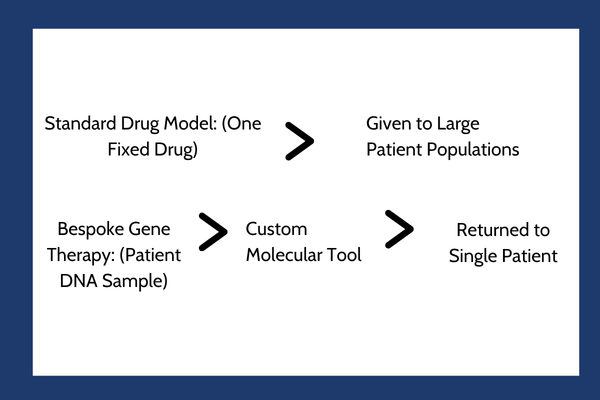
Traditional pharmaceutical models rely on mass production. Researchers test a single drug across large groups of people, manufacture it in vast quantities, and give it to millions who share the same general diagnosis. While this model works well for common health conditions, it leaves millions of people behind. There are over seven thousand known rare diseases, yet fewer than ten percent have an approved drug. Most of these conditions affect tiny groups of individuals, sometimes only a handful of patients worldwide. Commercial drug companies rarely invest the hundreds of millions of dollars needed to develop treatments for such small groups.
Bespoke gene therapy flips this standard model on its head. Rather than forcing a single drug to fit millions of patients, scientists analyze one person's genome to identify the exact spot where a mutation occurs. They then build a custom therapeutic package engineered to repair or correct that exact genetic code.
This approach relies heavily on precise genomic sequencing. Modern sequencing machines can read a human genome in hours, allowing medical teams to locate single base-pair changes almost instantly. Once researchers know the target sequence, they select an appropriate gene-editing tool to correct the error directly inside the cell.
The Historic Breakthrough for Baby KJ
The true potential of custom gene editing was recently demonstrated through the case of an infant known as Baby KJ. 1 Born with a severe metabolic disorder known as carbamoyl phosphate synthetase 1 deficiency, KJ was unable to process proteins safely. Without a functional version of this critical enzyme, toxic levels of ammonia built up in his blood shortly after birth. Standard care for this condition involves strict dietary limits, medications to bind excess nitrogen, and eventually a liver transplant.
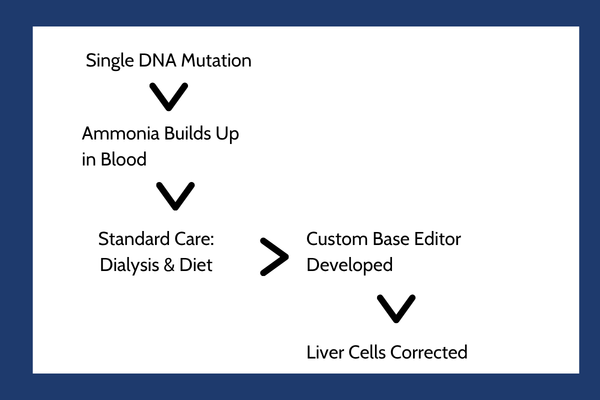
Because KJ carried a unique single-letter mutation, standard drug therapies could not fix the underlying cause. A dedicated team of scientists and doctors from public academic centers and private biotechnology partners quickly gathered to build a custom solution. They selected a technology called base editing, which acts like a precise pencil and eraser to change one genetic letter into another without cutting both strands of the DNA molecule.
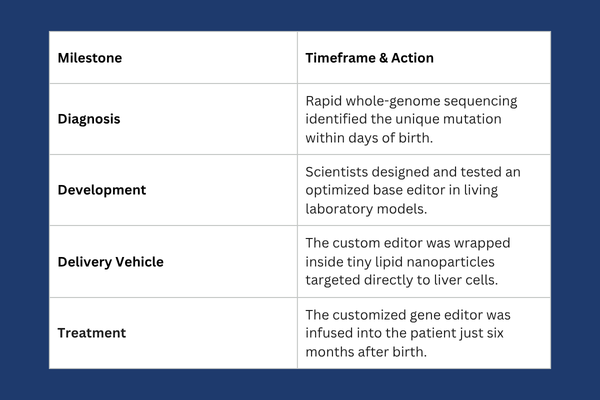
The results of this single patient trial showed clear signs of success. After his infusions, KJ tolerated higher levels of dietary protein and showed reduced dependence on nitrogen-removing medications, with no serious side effects. This rapid turnaround proved that a custom gene-editing therapy can move from design to human delivery safely in months rather than years. (A)
Broadening the Horizon: Progress in Huntington Disease
While single-patient treatments show what is possible at the individual level, bespoke gene tools are also creating pathways to treat complex inherited conditions that affect larger groups. Huntington disease is a fatal inherited condition caused by a repeating expansion in the huntingtin gene. This repeating sequence produces a toxic mutant protein that slowly destroys nerve cells inside the brain, causing loss of movement, cognitive decline, and psychiatric changes.
For decades, medical science struggled to slow the progress of this devastating condition. Recent clinical trials using targeted gene therapy vectors have broken that long standstill. An experimental therapy known as AMT-130 uses a modified harmless virus to deliver custom genetic instructions directly into deep brain structures. These instructions tell the brain cells to block the production of the toxic mutant protein.
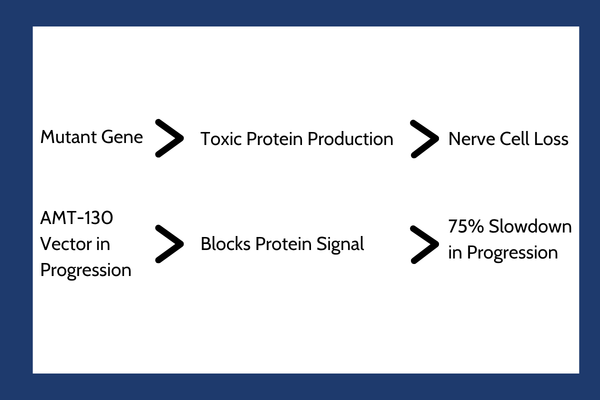
Clinical trial results revealed that high-dose groups receiving this targeted gene therapy experienced up to a 75 percent slowdown in disease progression over three years compared to expected natural decline. This functional preservation provides strong evidence that genetic interventions can protect delicate neural tissues from inherited defects. (B)
Defining N of 1 Therapies
Cases like Baby KJ represent a new classification in medicine: N of 1 therapies. In scientific research, the letter N stands for the total number of subjects in a trial. An N of 1 trial means the entire clinical trial is designed, executed, and evaluated for a single individual.
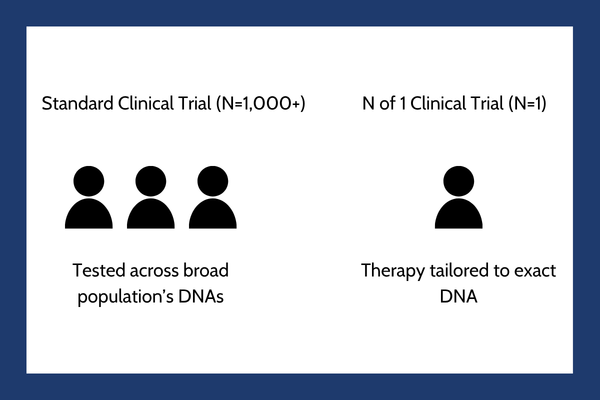
This model is fundamentally different from traditional drug development in several key ways:
Target Specificity: Standard drugs bind to broad biological pathways present in everyone. N-of-1 treatments target the exact sequence variation found in one person.
Modular Platforms: Researchers use standardized delivery tools like lipid nanoparticles or harmless viral shells, changing only the internal genetic code payload for each new case.
Speed of Creation: Because the delivery system stays constant, researchers can synthesize new therapeutic payloads in weeks once they identify the target DNA.
Direct Patient Testing: Preclinical testing focuses entirely on the patient's own cell samples in laboratory dishes to confirm safety before treatment begins.
By viewing the delivery system as a reusable vehicle and the genetic editor as software, medicine can create custom treatments for rare mutations without starting from scratch every single time.
Collaborative Networks and Regulatory Frameworks
Developing a unique drug for one individual requires breaking down traditional walls between academic researchers, regulatory agencies, and commercial drug companies. Public/Private partnerships have become the foundation of this progress.
Organizations like the Bespoke Gene Therapy Consortium2 bring together national health institutes, universities, and pharmaceutical corporations. Their goal is to create standardized operational playbooks for custom therapies, making the process faster and less costly.
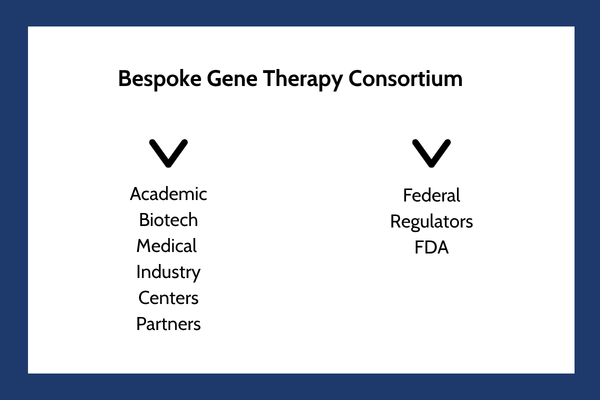
Regulatory agencies like the United States Food and Drug Administration have established updated draft guidance to help streamline N-of-1 clinical trials. These frameworks provide clear rules for safety testing, quality manufacturing, and reporting patient outcomes when a drug will be given to only one person. Anyone who wants to learn more about these collaborative efforts can visit the National Institutes of Health regulatory hub. (B)
Overcoming Challenges in Custom Gene Editing
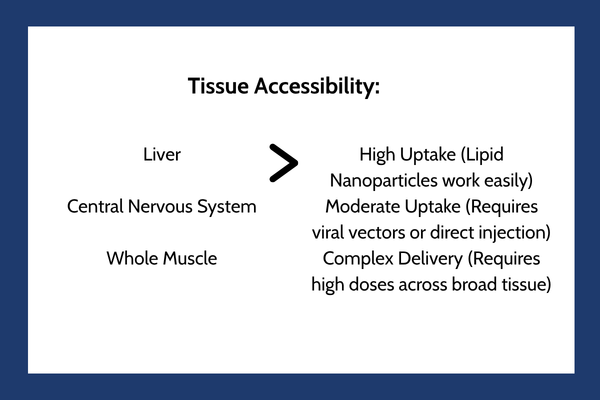
Despite notable early successes, expanding bespoke gene editing from isolated cases into standard medical care presents real hurdles. Delivering complex molecular tools to the right tissues remains a central challenge. While liver cells readily take up lipid nanoparticles, reaching cells in the brain, heart, or deep skeletal muscle requires specialized vector systems that are difficult to manufacture consistently.
Manufacturing costs also represent a major barrier. Producing a single batch of custom clinical-grade editor molecules under strict sterile conditions can cost hundreds of thousands of dollars. Finding sustainable ways to fund these treatments through public health programs or insurance coverage is essential so these breakthroughs do not remain restricted to a fortunate few.
Safety monitoring must also remain extraordinarily rigorous. Because N-of-1 therapies move quickly into human application, researchers perform extensive laboratory testing on patient cells to check for off-target editing, where the molecular tool cuts or alters unintended spots in the DNA sequence.
The Road Ahead for Personalized Medicine
Bespoke gene editing marks a permanent shift in how humanity approaches genetic disease. As base editors, prime editors, and gene delivery vectors continue to improve, the time needed to design and deliver a personalized treatment will continue to shrink.
The success seen in patients like Baby KJ shows that ultra-rare conditions no longer need to be considered incurable death sentences. By combining standardized delivery platforms, supportive regulatory pathways, and dedicated public/private partnerships, scientists are turning personalized genetic corrections into a reliable medical reality. The era of one-size-fits-all medicine is giving way to a future where every patient can receive a cure built specifically for them.
Navigate regulatory frameworks, accelerate development pathways, and commercialize cutting-edge genetic solutions. Contact Metis Consulting Services today and transform your strategic vision into clinical reality.
Sources:
1Innovative Genomics Institute, First Patient Treated with Personalized CRISPR Therapy, Developed in Just Six Months, May 15, 2025, by Andy Murdock
2Healthbeat, Huntington's Disease Progress in Gene Therapy, December 2025
3NIH, Gene Targeted Therapies, Bespoke Gene Therapy Consortium (BGTC)