
Continuous Manufacturing and ICH Q13: Regulatory Readiness at Scale
Guided by the landmark ICH Q13 guidelines, the global pharmaceutical industry is undergoing a revolutionary shift from traditional batch manufacturing to agile, continuous production systems. Read this Week's Guard Rail to explore the revolutionary shift from traditional batch manufacturing to agile, continuous production systems.
Guided by the landmark ICH Q13 guidelines, the global pharmaceutical industry is undergoing a revolutionary shift from traditional batch manufacturing to agile, continuous production systems. Read this Week's Guard Rail to explore the revolutionary shift from traditional batch manufacturing to agile, continuous production systems.
By Michael Bronfman
June 8, 2026
The global pharmaceutical industry is undergoing a major shift in how medicines are made. For many decades, pharmaceutical factories have relied on traditional batch manufacturing. In a batch system, medicine is made in separate steps. Workers mix ingredients in a large tank, stop the machine, transfer the mixture to another station, test it for safety, and then proceed to the next step. This process takes a long time because the materials sit in wait between each phase.
Today, a newer and faster method called continuous manufacturing is changing the field. Instead of stopping and starting, continuous manufacturing moves raw materials through a single, non-stop automated system. Ingredients enter at one end of the factory pipeline, and finished tablets or liquids emerge at the other end.
This modern method affords enormous benefits, but it also creates fresh challenges for global regulators who must ensure every pill is completely safe. To help factories adopt this technology, international experts developed a set of specific rules known as the ICH Q13 guidelines. This system is helping factories around the world upgrade their machinery while keeping patient safety as the top priority.
What is Continuous Manufacturing?
To understand this industrial evolution, it helps to think about how a modern car factory works. Cars are not built by hand one at a time in separate rooms. Instead, they move down an assembly line where any part is added in a continuous, smooth flow. Continuous manufacturing applies this exact same logic to chemistry and medicine.
In a traditional batch setup, if a company wants to produce 1 million doses of a drug, it might need to run 5 separate batches. Each batch requires its own setup, cleaning schedule, and quality testing. If something goes wrong during step three of batch two, the entire batch may have to be scrapped, costing the company time and money.
Continuous manufacturing eliminates those separate steps. Machines run constantly for days or weeks at a time. Raw chemical powders are fed into the system at a precise rate and blended by automated mixers. Then they are compressed into pills and continuously coated.
This constant flow improves production. It also requires a much smaller factory footprint. A continuous manufacturing facility can often fit into a room one-third the size of a traditional batch factory, reducing energy use and building costs.
The Challenge of Process Validation and Lifecycle Management
Because continuous manufacturing runs dynamically, it cannot be monitored using old methods. In a batch system, a scientist can walk up to a large tank, scoop out a sample of powder, and take it to a lab to test its purity. In a continuous system, the material is constantly moving through pipes and tubes at high speeds. Stopping the machine to take a sample would ruin the entire production run.
This active flow elicits crucial questions concerning process validation. Process validation is the collection of data that proves a manufacturing process can reliably produce safe, high-quality medicine. Regulators require pharmaceutical companies to prove that their systems are always under control.
To achieve this control, factories use advanced tools known as Process Analytical Technology. Instead of taking physical samples, engineers place optical sensors directly inside the production pipes. These sensors use infrared light and lasers to inspect the chemical makeup of the moving powder in real time.
If the mixture deviates even slightly from the correct formula, the computer system detects the error instantly. The system can then automatically adjust the feeders' speeds or divert the flawed material to a waste bin without stopping the rest of the production line.
Managing this technology over time is known as lifecycle management. As machines age, sensors can lose accuracy, and software needs to be updated. Pharmaceutical companies must have strict plans in place to maintain, test, and calibrate these digital instruments throughout the entire lifespan of the manufacturing line.
Understanding ICH Q13 and Global Regulatory Harmony
Because different countries have their own individual health ministries, pharmaceutical companies routinely face a confusing web of rules. A factory design that is approved in the United States might face different questions from regulators in Europe or Japan. This lack of agreement can delay the release of important global medicines.
To solve this issue, the International Council for Harmonization created the ICH Q13 guideline. The goal of this document is to establish a single, internationally accepted standard for continuous manufacturing. You can read the specific technical details and formal announcements by visiting the ICH Guidance Documents page.
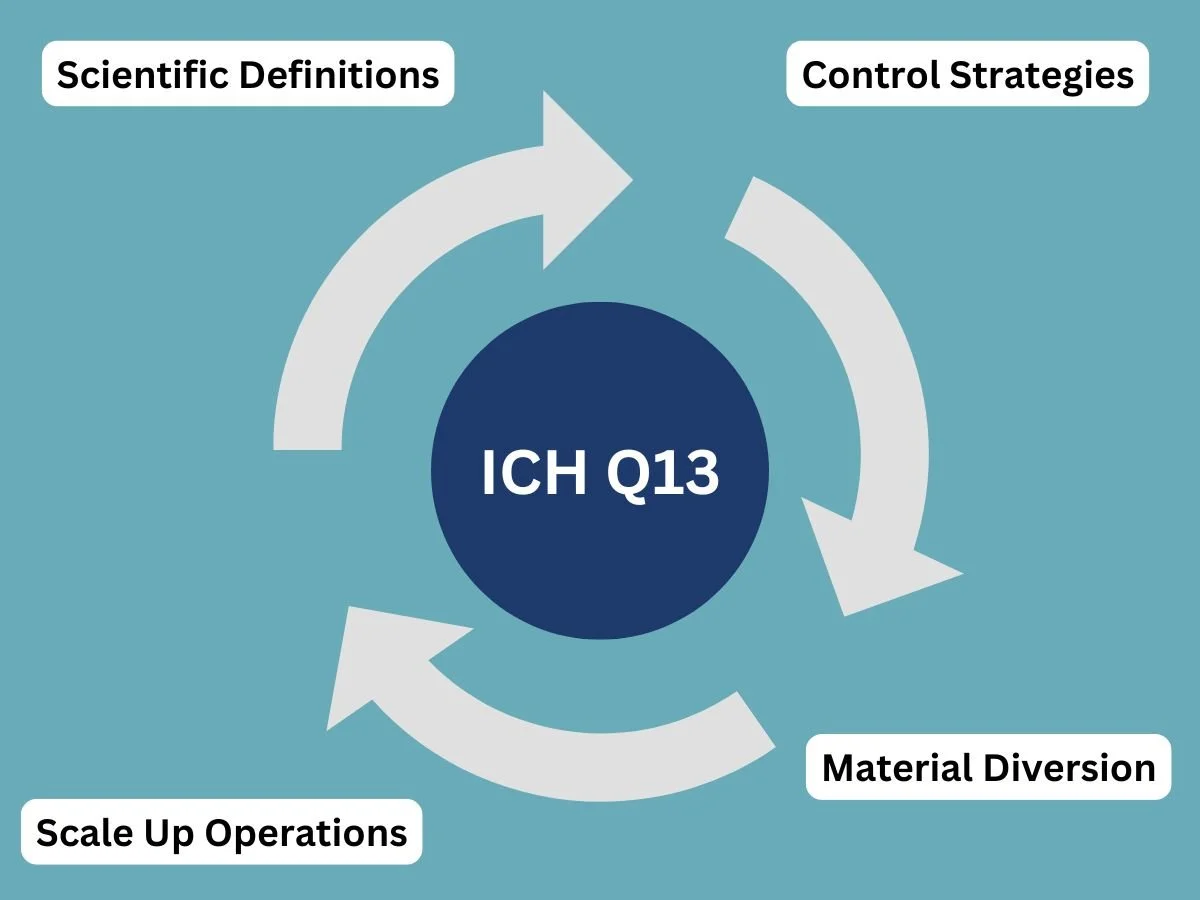
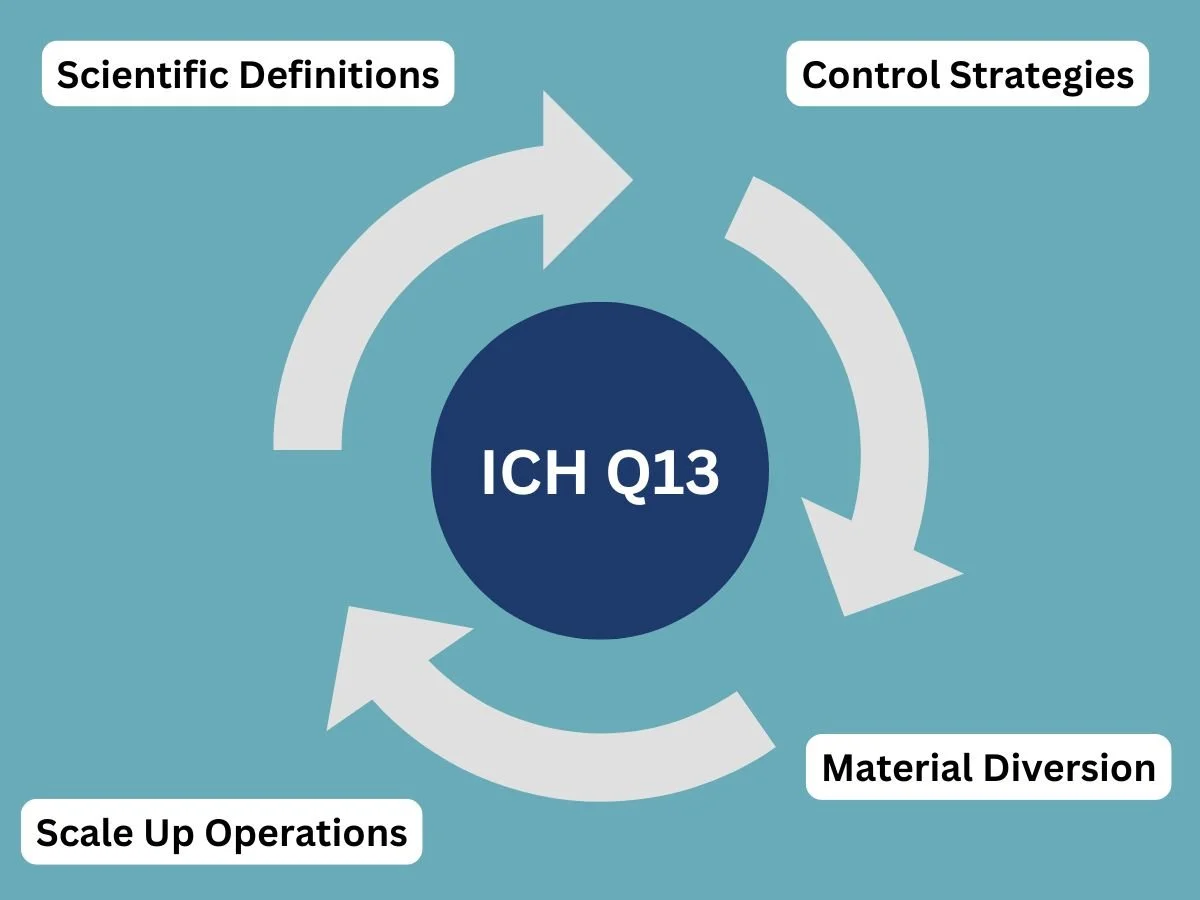
The ICH Q13 framework gives unambiguous instructions on how companies should handle key manufacturing concepts, including:
Scientific Definitions: Defining exactly what constitutes a batch when the material never stops flowing.
Control Strategies: Explaining how to use real-time sensors to monitor product quality.
Material Diversion: Setting rules for how and when a machine should discard substandard materials during production.
Scale Up Operations: Explaining how a company can increase production volume by simply running the machines longer, rather than building larger equipment.
By setting up these uniform rules, ICH Q13 brings global regulatory readiness to scale. It provides health inspectors with a clear checklist for reviewing these advanced facilities, thereby speeding up and making the approval process more predictable for everyone involved.
Helping Smaller Pharmaceutical Companies Innovate
In the past, only the largest global pharmaceutical corporations had the money and scientific expertise to build continuous manufacturing lines. These projects required millions of dollars in custom engineering and hundreds of hours of consultation with regulatory experts to demonstrate that the systems were safe.
The arrival of the ICH Q13 guidelines changes the landscape. Because the rules are now clearly written down and agreed upon by global authorities, the path to implementation is much easier to follow. This foreseeability makes it feasible for smaller pharmaceutical companies with less internal expertise to employ this manufacturing approach.
Instead of designing a system from scratch, smaller manufacturers can purchase pre-validated equipment that already meets international standards. They can look at the ICH Q13 document as a step-by-step blueprint for compliance. This opening of technology means that smaller companies specializing in rare diseases or generic medicines can also benefit from the efficiency, speed, and cost savings of continuous production.
Enhancing Drug Supply Chain Resilience
One of the greatest benefits of shifting to nonstop production is its contribution to the global drug supply chain. The medical world frequently faces drug shortages caused by factory delays, contaminated batches, or sudden spikes in demand during public health emergencies.
Traditional batch manufacturing is slow to react to these crises. If a hospital suddenly needs double the amount of a specific antibiotic, a batch factory has to source more raw ingredients, schedule new production slots, and run multiple separate batches over several weeks.
Continuous manufacturing solves this problem through flexibility. To scale up production in a continuous facility, you do not need to buy bigger tanks or redesign the process. You simply keep the existing machines running longer. If a machine is scheduled to run for twenty-four hours, engineers can keep it running for seventy-two hours instead.
This ability to rapidly scale production helps prevent shortages and assures that life-saving medicines remain available to patients during emergencies. For perspectives on how these supply chain improvements are being integrated into the wider medical field, you can review current industry analysis on the ISPE Continuous Manufacturing Resources Portal.
The Future of Pharmaceutical Engineering
As more factories adopt continuous manufacturing and follow ICH Q13 standards, the entire pharmaceutical domain will continue to evolve. We are already seeing the integration of fabricated intelligence along with machine learning into these automated lines. Computers can now analyze data from thousands of sensors simultaneously, predicting when a mechanical part might fail before it actually breaks down.
This high level of automation also reduces human error. Because humans do not need to manually scoop powders or transfer materials between stations, the risk of accidental contamination drops drastically. The entire process becomes cleaner, safer, and more efficient.
The transition from batch production to continuous manufacturing represents a true revolution in pharmaceutical engineering. While adjusting to these flexible validation tools entails considerable effort from both scientists plus regulators, the rewards are clear. Through international cooperation and guidelines such as ICH Q13, the pharmaceutical industry is building a more durable, scalable, and reliable system for protecting human health worldwide.
To better understand how this digital evolution affects the greater healthcare sector, we must examine how regulatory readiness shapes the commercial market. When factories adopt advanced automated systems, they do not just change their internal mechanics. They alter how quickly new therapies can reach the market.
For a closer look at how these manufacturing advancements affect actual product availability and commercial rollouts, you can track the latest pharmacy inventory updates. This connection shows that factory-floor innovation directly affects what is available on local pharmacy shelves.
Training the Next Generation of Specialists
As the industry transforms away from manual methods, the training required for pharmaceutical workers is also evolving. The modern factory floor looks more like a high-tech computer lab than a traditional chemical mixing plant.
Engineers must be fluent in data assessment, software maintenance, and mechanical engineering. They need to understand how to read complex up-to-the-minute data streams to spot microscopic variations in product density or moisture levels.
This demand for highly specialized skills has led to new partnerships between universities and industrial leaders. Educational programs are updating their chemistry and engineering courses to focus heavily on continuous processes and international regulatory frameworks.
By training students on the exact tools used in modern automated facilities, the academic world ensures that the workforce is fully prepared to operate complex systems. This educational pivot helps smaller businesses build internal expertise without hiring expensive outside consulting firms.
A Cleaner Blueprint for Global Health
Finally, the combination of advanced technology and clear international rules provides a cleaner, progressively sustainable blueprint for global public health. By limiting waste, reducing factory energy requirements, and dropping the rate of failed batches to near zero, continuous production creates a much more reliable pharmaceutical infrastructure.
When a factory runs smoothly without interruptions, manufacturing costs drop, ultimately assisting the individual patient paying for prescriptions.
The ongoing harmonization of these rules means that a breakthrough discovered in one corner of the world can be rapidly scaled up and manufactured across multiple continents using the exact same validated guidelines. This level of global readiness ensures that humanity is better prepared to address future health challenges quickly, efficiently, and in accordance with strict safety standards.
Ready to seamlessly transition your company through the complexities of ICH Q13 and the process validation, regulatory compliance, and on to the future of pharmaceutical engineering. Contact Metis Consulting Services today.