
Moving Beyond the Sandbox: How to Build Inspection-Ready AI in Regulated Life Sciences
For years, AI was just a tool for simple tasks like drafting emails. Those days of casual use are over. Regulators are tightening expectations, demanding strict AI governance, perfect traceability, and full integration with quality compliance systems. These rules are no longer optional best practices.
As global regulators rapidly tighten enforcement on pharmaceutical companies, this week we look at the high-stakes gap between flashy AI pilots and the rigorous, audit-ready validation required in the life sciences sector. Manufacturers must have systems in place for bulletproof governance to survive their next inspection.
By Michael Bronfman
June 30, 2026
Many pharmaceutical companies live in a frustrating middle ground. You can see it in boardrooms and IT departments everywhere. Teams enthusiastically say, “We are experimenting with artificial intelligence!” Yet when asked whether that same technology is ready for an official regulatory inspection, the room falls silent.
The gap between a cool pilot project and a fully validated, inspection-ready system is where most life sciences companies currently find themselves.
For years, teams treated artificial intelligence as a collection of non-product tools used for simple tasks. It might have been used to summarize long documents or draft email templates. But the days of casual experimentation are officially over. Regulatory bodies are tightening their expectations. They are demanding strict AI governance, perfect traceability, and complete integration with quality compliance systems. They are no longer leaving these rules to optional best practices.
Artificial intelligence systems inform labeling, product performance claims, drug dosing, patient safety, or quality decisions; they face a tough reality. The entire solution must fulfill rigorous quality, validation, and lifecycle controls. Generic pilots fail to scale because they lack the foundation required to survive a regulatory audit. Life sciences organizations must shift to purpose-built artificial intelligence that incorporates strict governance controls, unalterable audit trails, and validated results to succeed.
The Shift in Regulatory Reality
Why do generic pilots fail?
To understand this, look at how global authorities view technology. The Food and Drug Administration released major updates that signal a strong enforcement posture for advanced software used in regulated spaces. The agency treats high-risk artificial intelligence with the same seriousness as physical medical devices or critical manufacturing tools.
Traditional software validation worked well for static systems. In the past, computer systems validation followed a predictable path. A developer wrote code, a quality team tested that it did exactly what it was supposed to, and the software never changed unless an engineer manually updated it.
Artificial intelligence contradicts this old way of thinking. Advanced models are dynamic. They are built to learn, observe patterns, and develop over time. Because these systems can evolve based on the information they process, standard testing methods are inadequate. Software cannot be tested once and assumed to behave exactly the same way a year from now.
Regulators are fully aware of this challenge. They are looking closely at:
Design Controls: How the model was built, chosen, and structured.
Model Validation: Proof that the mathematical formulas produce accurate, repeatable results.
Data Authenticity: Complete certainty that the information feeding the model is clean and unaltered.
Risk Management: Clear plans for handling unexpected errors.
If an inspector walks into your facility today and sees an advanced tool helping your quality team make decisions, they will ask tough questions. They will want to know how you verify the output. They will want to see how you track changes in the system. If your only answer is that a vendor told you the tool works, you are facing a major compliance risk.
Why Generic AI Pilots Fail to Scale
It is incredibly easy to build a successful pilot project. A small team can upload historical quality data into a popular, generic large language model. Within an afternoon, the tool can review past records and suggest draft standard operating procedures or summarize corrective and preventive action reports. The team celebrates, declares the project a success, and plans to roll it out to the whole company.
Then, they meet the quality assurance department.
Generic artificial intelligence applications are built for mass productivity, not the high-stakes world of life sciences. When you try to push a basic pilot into a Good x Practice environment, the system usually falls apart for several reasons.
The Opaque Decision Process
Generic models operate like a black box. A user submits a question, and the tool provides an answer, but no one can trace the exact path the software took to reach that conclusion. In a regulated environment, an untraceable answer is a non-compliance finding waiting to happen. If you cannot prove how your software reached a conclusion about a batch failure or a clinical trial data point, you cannot use that conclusion.Missing Explicit Intended Use
Validation cannot be generic. You cannot validate an advanced tool for general office work and then use it to triage quality investigations. Every application must have a clearly defined intended use statement. This statement must outline the exact process the tool supports, who the users are, what source systems feed it data, and how the output impacts human health or product quality. Generic tools are not built to restrict themselves to a single, tightly controlled workflow.Model Drift and Information Degradation
When an advanced model interacts with new data, its internal weights can shift. Over time, the system's accuracy can degrade or change, a phenomenon termed as model drift. Generic applications do not include built-in alerts that notify you when the software becomes less accurate. Missing continuous tracking protocols, a tool that worked perfectly during a pilot in January might give flawed recommendations during an inspection in November.Poor Data Lineage and Security
Where does the information go when you type it into a generic tool? Does the vendor use your proprietary molecule data to train their public models? Many basic applications lack clear data lineage. They cannot prove who had access to the data, how it was modified, or where it is stored. This violates fundamental data validity principles that require all records to be fully traceable and secure.
The Core Pillars of True AI Governance
Transitioning from an experimental sandbox to a validated environment requires a formal governance structure. Organizations must stop treating advanced tools as simple IT upgrades and start treating them as highly regulated assets. True governance rests on five core pillars.
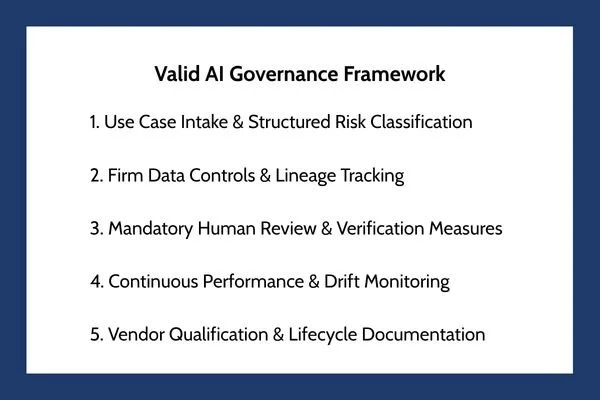
Pillar 1: Use Case Intake and Risk Classification
You should not give every department open access to activate advanced tools whenever they want. A mature company implements a formal intake process. Before a single line of code is written or a vendor software is purchased, the business must capture the exact purpose, ownership, and expected benefit of the tool.
The tool must be classified by risk once captured. A helpful framework divides applications into three buckets:
High Risk: Systems that support clinical decision making, patient safety, quality control inspections, or deviation management. These require absolute validation rigor, design controls, and intense testing.
Medium Risk: Tools used for operational forecasting, supply chain streamlining, or trend analysis. These require clear procedural controls and standard validation.
Low Risk: Systems used for simple productivity, basic grammar corrections, or internal meeting scheduling. These require basic security reviews but minimal validation.
By tying your compliance controls directly to the risk level, you avoid over-documenting low-risk tools while assuring high-risk applications are bulletproof.
Pillar 2: Data Controls and ALCOA+ Principles
Every piece of information used by an advanced system must comply with strict data-integrity guidelines. This means all data must be attributable, legible, contemporaneous, original, and accurate. It must also be complete, consistent, enduring, and available.
Purpose-built solutions enforce these principles by creating strong data boundaries. They restrict the software so it can only access approved, verified source systems. They block the tool from pulling random information from the public internet. Furthermore, the system must keep an immutable audit trail. Every single prompt, every generated response, and every user validation must be permanently stamped with a time, date, and user identity.
Pillar 3: Mandatory Human Review
No advanced system should operate completely on autopilot when product quality or human lives are on the line. Governance frameworks ought to mandate a qualified human reviewer to check the work.
The software acts as an assistant, not the final judge. If the tool drafts a response to a quality deviation, a trained quality professional must review the source data, verify the accuracy of the draft, and officially sign off on the record. The system must store this human verification as part of the permanent compliance history.
Pillar 4: Continuous Performance Monitoring
Because advanced software can shift over time, you need a preemptive strategy to catch errors before they reach an auditor. This involves formulating clear metrics for model exactness, sensitivity, and fault rates.
Organizations must run regular challenge tests. These tests feed the system known data sets to verify that it still produces the expected results. If the performance drops below some threshold, it must trigger an automatic alert. The tool is then taken offline or restricted until a change control process evaluates the issue and revalidates the configuration.
Pillar 5: Thorough Vendor Qualification
Most companies do not build advanced language models from scratch. They partner with IT providers or integrate specialized software into their operations. However, regulators hold you responsible for your vendors' compliance.
You must thoroughly audit your technology partners. You need to inspect their security measures, bias detection protocols, and change control processes. If a vendor pushes an unannounced software update that alters how the model reasons, your validated status could vanish instantly. You must use vendors that offer complete honesty and give you control over when updates are applied.
Applying Computer Software Assurance to Advanced Systems
The thought of validating a dynamic, learning model can terrify traditional quality assurance teams. If you try to apply old, paperwork-heavy computer systems validation methods to advanced software, you will quickly find yourself buried in endless documentation. A typical project could take eight months to complete, destroying your competitive advantage.
Fortunately, the regulatory domain has evolved. The finalized computer software assurance guidance provides a modern framework that aligns perfectly with advanced technology.
Computer software assurance flips the script on validation. Instead of spending eighty percent of your time writing exhaustive test scripts and twenty percent on critical thinking, this system tells you to spend most of your time on risk analysis and critical thinking. It allows teams to focus their testing energy on the specific functions that directly impact product quality and patient safety.
When you apply this approach to advanced technology, validation becomes manageable. Instead of testing every likely response the tool could ever generate, you focus on the workflow's configuration. You test the boundaries, the data connectors, the human review steps, and the failure modes.
Organizations that utilize this risk-based framework see massive improvements. Validation timelines can drop from several months to just a matter of weeks. This allows life sciences companies to deploy powerful, automated solutions quickly without sacrificing a single shred of regulatory compliance.
How Purpose Built Compliance Platforms Solve the Problem
Living in the gap between a pilot and a validated system is dangerous and expensive. It wastes time, frustrates engineers, and leaves your business exposed to severe regulatory penalties. The solution is to step away from generic tools and adopt systems built from the ground up for regulated environments.
This is where specialized platforms make a massive difference. For instance, companies planning to manage their complex operations turn to dedicated provider ecosystems like PSC Software. Instead of trying to force a consumer application to comply with strict global laws, organizations leverage platforms designed with compliance as a core feature.
When you look at the product offerings within the life sciences ecosystem, you can see how purpose-built tools bridge the gap. For example, managing the intense training demands of a regulated workforce requires absolute precision. Neither a manual spreadsheet nor a standard corporate training tool can withstand the pressure of an audit. Using an automated option like the ACE LMS software solution ensures that every training event, standard operating procedure update, and employee qualification is tracked inside an unalterable audit trail. This level of control perfectly aligns with the information-consistency standards required for advanced automation.
Traditional validation paperwork can slow an organization to a crawl. Converting to a digital, paperless environment using tools like ACE Validation's paperless GxP software allows teams to unify their compliance activities. With document control, corrective actions, and validation records live in a single, connected digital ecosystem, implementing and monitoring advanced technology becomes simple, enabling effortless tracking of data lineage, transparent management of system changes, and a clear, organized history for any inspector who walks through your door.
A Practical Roadmap to Inspection Readiness
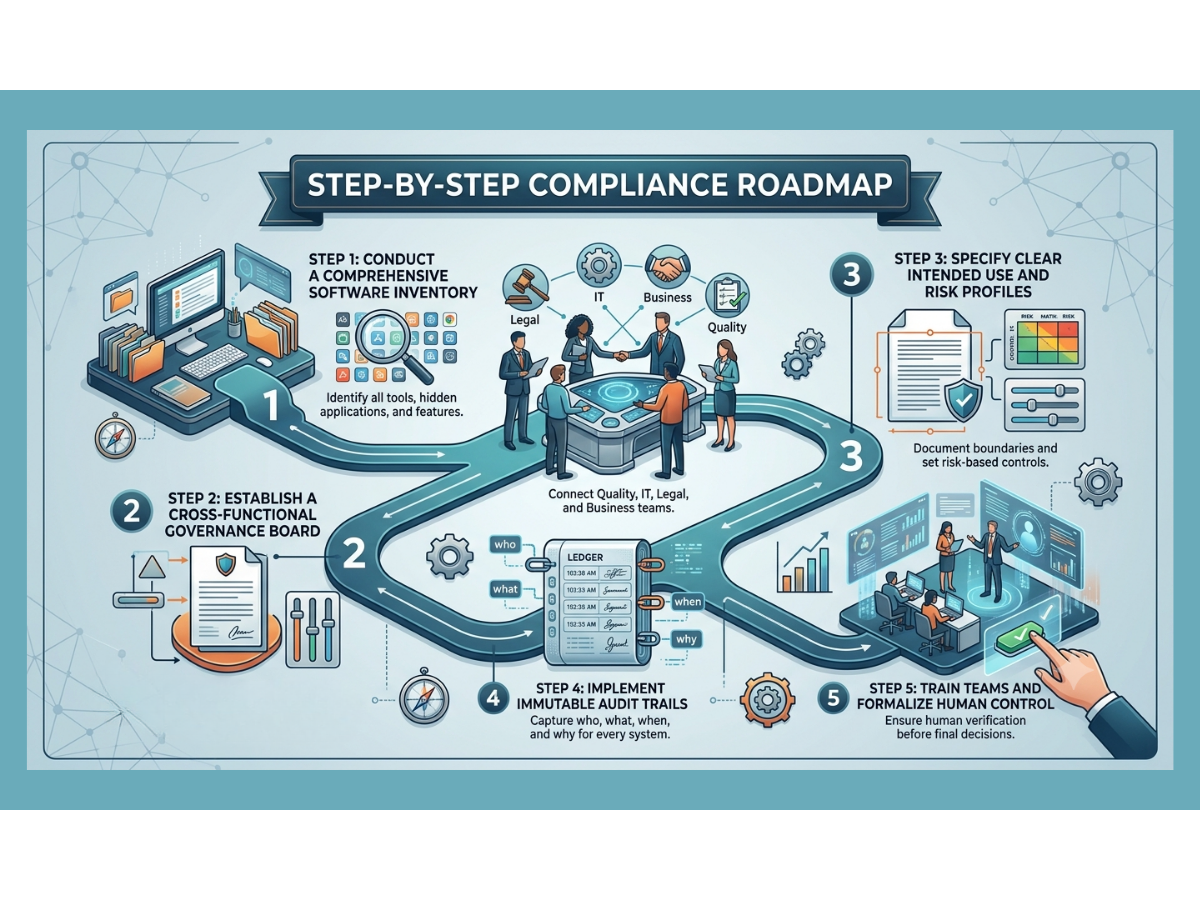
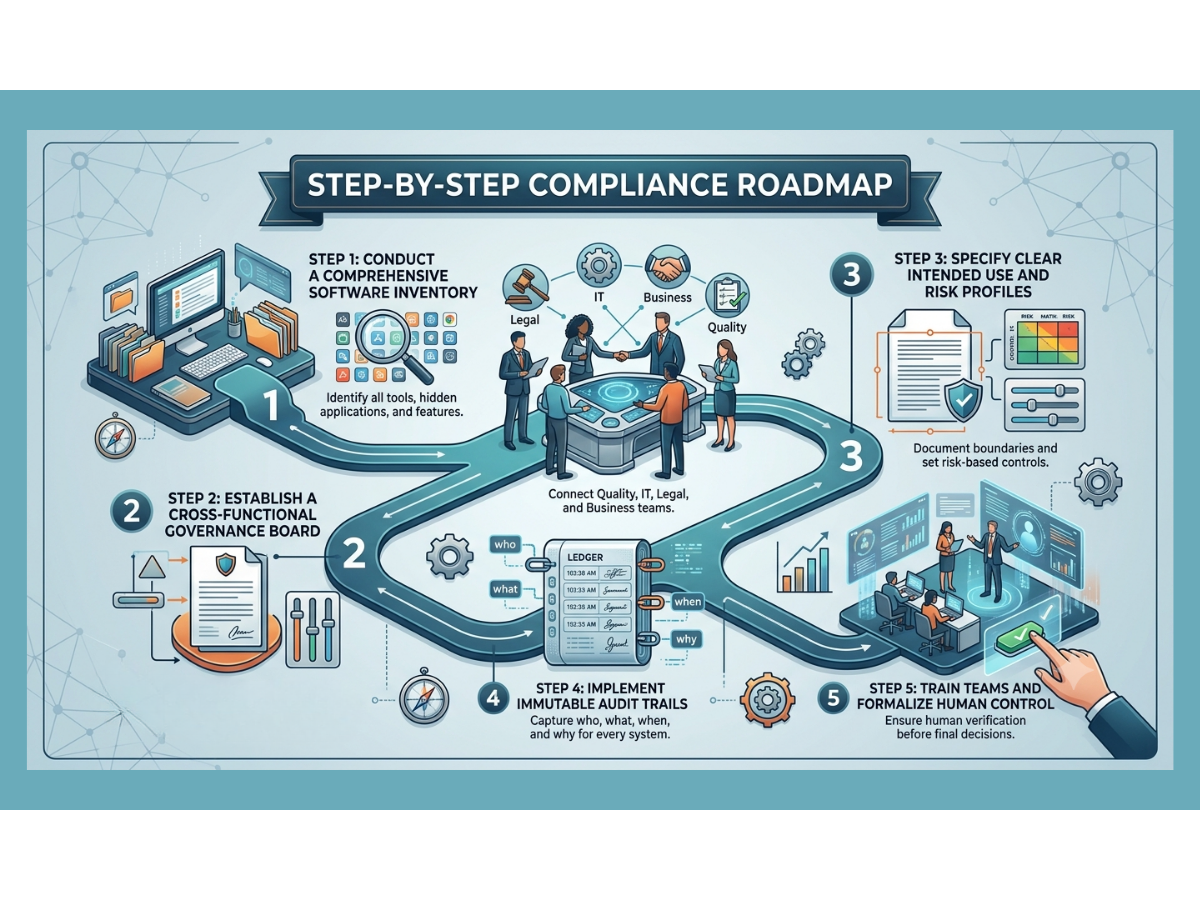
If your organization wants to close the gap and build artificial intelligence systems that are truly inspection-ready, you must follow a clear, step-by-step roadmap.
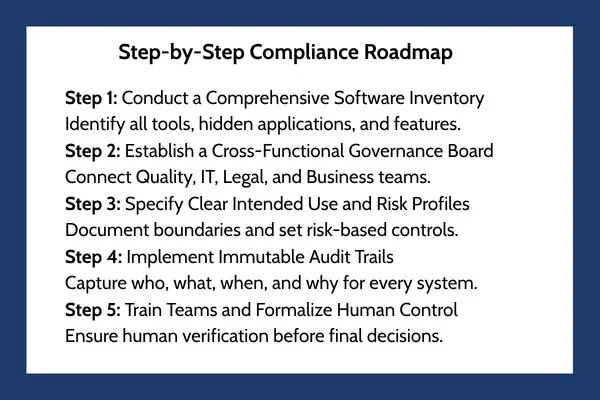
Step 1: Inventory All Advanced Tools
You cannot govern what you do not know exists. Conduct a thorough audit across your business to discover every tool currently in use. Look for hidden applications where employees might be pasting company data into public websites. Document every vendor-supplied feature that claims to use smart automation.
Step 2: Create an Internal Governance Board
Bring together leaders from quality assurance, information technology, legal, and operational business units. This group will serve as the gatekeepers for all automation projects. They will review new use cases, assign risk classifications, and confirm that no project moves forward without a clear validation plan.
Step 3: Draft Clear Intended Use Statements
For every approved tool, write a detailed statement explaining exactly what the software is allowed to do and what it is strictly prohibited from doing. Document the data sources, the human review workflows, and the exact records the system will generate.
Step 4: Enforce Technical Data Controls
Work with your IT team or software vendors to confirm that every system has strong access controls, data encryption, and unalterable audit trails. Verify that the system layout prevents automatic model updates without requiring formal change control.
Step 5: Establish Continuous Monitoring Standards
Create a schedule for regular performance reviews. Define your drift thresholds and write clear standard operating procedures for what the team must do if the software shows signs of declining accuracy.
Final Thoughts
Artificial intelligence offers incredible potential for the pharmaceutical industry and can help us analyze massive data sets, spot manufacturing deviations early, and streamline heavy documentation workloads. But these benefits mean absolutely nothing if the technology cannot survive a regulatory inspection.
The era of playing around with casual pilots is over. Regulatory bodies are stepping up enforcement, and the companies that succeed will be those that treat automation with the discipline it deserves. By shifting away from generic tools and deploying purpose-built software, sound risk frameworks, and complete data lineage, you can confidently move your technology out of the sandbox and into a fully validated, inspection-ready reality.
Bridge that gap between AI innovation and regulatory reality. Contact Metis Consulting Services today. We are experts who can streamline your computer software assurance, fortify your governance structure, and ensure your technology is fully validated and completely inspection-ready.

How to REMS – A Practical Regulatory Guide
Risk Evaluation and Mitigation Strategies, or REMS, are required by the FDA for certain drugs with serious safety concerns. The goal of a REMS program is to ensure that the benefits of a drug outweigh its risks.

This week in the Guardrail, we look at mastering the FDA’s toughest safety oversight protocols -REMS. As scrutiny intensifies, your team must move beyond simple checkboxes to build a truly resilient system.
Written by Michael Bronfman
Risk Evaluation and Mitigation Strategies, or REMS, are required by the FDA for certain drugs with serious safety concerns. The goal of a REMS program is to ensure that the benefits of a drug outweigh its risks. REMS programs can be complex and highly visible to regulators. Companies must be prepared not only to design and implement a REMS but also to demonstrate that it works.
REMS inspections are increasing in depth and frequency. Being prepared requires a clear understanding of regulatory expectations, strong operational controls, and a culture of compliance.
When a REMS Is Required
The FDA may require a REMS at the time of approval or after a drug is on the market. This decision is based on known or potential risks associated with the product.
REMS may be required when labeling alone is not enough to manage risk. Examples include drugs with serious side effects, high misuse potential, or risks related to pregnancy or long-term use Understanding when and why a REMS is required helps sponsors plan early and avoid delays.
FDA information on REMS
Key Components of a REMS Program
Not all REMS programs are the same. Some are simple, while others are complex and involve multiple stakeholders.
Common REMS components include:
Medication guide – information provided to patients about risks
Communication plan – educational outreach to healthcare providers
Elements to assure safe use – such as prescriber certification, pharmacy certification, patient enrollment, or monitoring requirements
Each component must be clearly defined and supported by procedures and training.
The FDA provides REMS guidance .
Regulatory Expectations for REMS Inspections
During a REMS inspection, FDA investigators focus on whether the program is implemented as approved and whether it effectively manages risk.
Inspectors will review policies, procedures, training records, and systems used to support the REMS. They may also interview staff responsible for REMS operations.
Key expectations include clear role definitions, documented processes, and evidence of oversight. Sponsors must show that they monitor compliance and address issues promptly.
Failure to meet REMS requirements can lead to warning letters, fines, or other regulatory actions.
Documentation Is Critical
Documentation is one of the most important aspects of REMS readiness. Every part of the program must be supported by written procedures.
This includes how prescribers are certified, how patients are enrolled, how data is collected, and how compliance is monitored.
Inspectors often ask to see examples of records. Missing or inconsistent documentation is a common inspection finding.
Companies should ensure that records are complete, accurate, and easy to retrieve.
Training and Accountability
Training is a core regulatory expectation for REMS programs. Staff involved in REMS activities must understand their responsibilities.
Training records should show who was trained, when training occurred, and what content was covered. Refresher training should be provided when procedures change.
Accountability is equally important. Roles should be clearly assigned, and oversight should be documented.
Strong training programs reduce the risk of errors and inspection findings.
Monitoring and Auditing REMS Performance
Sponsors are expected to monitor REMS performance on an ongoing basis. This includes tracking compliance with program requirements and identifying trends.
Regular audits help identify gaps before they become regulatory issues. Audit findings should be documented, and corrective actions should be implemented and tracked.
FDA guidance emphasizes the importance of continuous evaluation of REMS effectiveness
Inspection Readiness Best Practices
REMS inspection readiness should be built into daily operations. Waiting for an inspection notice is too late.
Best practices include:
Maintaining up-to-date procedures
Conducting mock inspections
Ensuring staff can confidently explain the program
Centralized documentation systems help ensure consistency and access. Leadership involvement reinforces the importance of REMS compliance.
Evolving REMS Inspection Trends
REMS inspections are becoming more detailed. Inspectors increasingly focus on how data is used to evaluate effectiveness.
They may ask how the sponsor determines whether the REMS is meeting its goals. They may also review how changes to the program are assessed and implemented.
Technology systems used to support REMS are also under greater scrutiny. Data accuracy, security, and access controls are key areas of focus.
Sponsors should be prepared to explain system validation and oversight.
Managing Third-Party Vendors
Many REMS programs rely on third-party vendors. These vendors may manage call centers, data systems, or training.
While vendors perform the work, the sponsor remains responsible. Inspectors will review vendor oversight and contracts.
Clear agreements, regular performance reviews, and documented oversight are essential. Vendor issues are a common source of REMS inspection findings.
REMS Modifications and Updates
REMS programs may need to be modified over time. Changes may be driven by new safety information or operational challenges.
Regulatory expectations for REMS modifications are strict. Changes must be reviewed and approved by the FDA before implementation unless otherwise permitted.
Sponsors should maintain clear change control processes and documentation.
Preparing for the Inspection Day
On the day of a REMS inspection, preparation makes a difference. Staff should know who will interact with inspectors and where documents are stored.
Responses should be clear and factual. If information is not immediately available, it is better to follow up than to speculate.
A calm and organized approach supports a positive inspection outcome.
Looking Ahead
REMS programs are a critical tool for managing drug safety. Regulatory scrutiny in this area will continue to increase.
Companies that invest in strong REMS design, clear documentation, and continuous monitoring are better positioned to meet expectations.
REMS compliance is not just a regulatory requirement. It is a commitment to patient safety and public trust.
Is your safety strategy ready for the spotlight? Don’t wait for a knock at the door—Contact Metis Consulting Services to sharpen your oversight and secure your path to market

Audit & Inspection Readiness
Inspections and audits allow the pharmaceutical sponsor to improve its processes and demonstrate continual improvement in every department and phase of the process.

Written by Li-Anne Rowswell Mufson
This month we will discuss Audit and Inspection Readiness
Last month, we talked a little bit about People’s perception of Quality teams, inspectors, auditors, and “the police” and how that isn’t what our goals should be with Internal and External Audits. This month we are going to talk about how to get the most out of “mock Inspections” Practice Interviews and how to be ready for Audits and Inspections
Why are inspections and audits important?
Inspections and audits allow the pharmaceutical sponsor to improve its processes and demonstrate continual improvement in every department and phase of the process.
While Inspectors may come in with a stated focus—for example, they may focus on GCP—depending on what they discover, they may “Pivot” and talk extensively with another department. For example, the organization may expect them to stay in manufacturing, but they wind up focusing on Pharmacovigilance.
So the organization needs to plan ahead so all departments are ready.
Steps in Performing an Audit
First step you need an Audit Calendar
Internal, Vendors, Suppliers, and Partners: This should not necessarily be every year, but there should be training and audits on the calendar every year. Determined by the Quality Department. This Ensures compliance with regulations and objectives and shows how good you are at what you do.
Doing actual run-throughs of interviews and inspections
Identifying the right “Key people”
Performing the due diligence and auditing your vendors actually ensures that they are qualified to do the job they are contracted to do. The Sponsor is the responsible party.
Don’t just check the box.
Identifying the Right Key People
Identifying the Right Key People—Who will be selected to be in front of an inspector? It is very important to choose key people to represent for a “mock” inspection. The same personnel who are chosen need to present for a “mock” inspection as well. If folks cannot answer questions in their immediate remit, they shouldn’t be there. But staff should understand that this is an opportunity to show how good you are at your job.
Key people from every department who know the documents and systems of their department. Choose people who will answer all questions honestly and directly without guessing or speculating. They should refer any questions that can't be answered to someone who can. Regulatory agencies expect employees to be trained to do this. Don't "hide the truth" because it will make you look bad. Don't state your opinion, don't volunteer information that was not asked for. "Shine"
Such a person might be asked, “Do you know what problems exist?”
If that person can say, “Yes, and this is how we are working on it,” you’re golden.
If the auditor has to tell you what the problem is, you are in trouble. It is an uncomfortable conversation. A 483 because the health authority had to tell you what the problem is means that communication within the organization is probably an issue as well.
An Internal Audit should be used to identify and address problems or concerns that exist in the systems. Again, you don't want the Health Authority to be the one to let you know about any issues.
Communication issues—Listen to your team Members if they tell you about an issue. Put it on a project plan so you’ve at least acknowledged a difficulty and put it on the “to-do List.” Sometimes, the people on the ground who are doing the work may request to have issues included in an internal audit. It may serve to open communication with the folks at the top.
The Sponsors Responsibilities
The Sponsor is the ultimate responsible party for all activity related to their product. Often, a client will say, “My vendor does that.” And while that may be true, the Sponsor can’t abdicate that responsibility. This is when having an external body to do those kinds of audits can be really beneficial. It promotes the relationship between the functional area or contract owner and the Quality Organization. Because the Quality Organization is now supporting the function in the preparation. An objective 3rd party doesn’t share the organization’s bias.
Regulatory agencies prefer independent third-party audits so that the potential for conflict of interest can be eliminated. When you use the in-house team for auditing a vendor, it is like having the fox watch the hen house. If you use the same company as the vendor, you are essentially outsourcing the bias. We do need to trust the vendors and have a collaborative attitude, BUT the oversight is also the responsibility of the Sponsor. So bringing in a 3rd party to audit vendors and even internally. This means you have a neutral Auditor. And your Quality team can be even more helpful to you. In preparation and response.
Avoid common 483 observations like "FIRM FAILED TO FOLLOW ITS OWN SOP." Don’t let this happen in your organization. Train everyone to be familiar with all SOPs and documents relevant to the department's work. Get revisions done in a timely manner.
Get your Documentation in order
List all Documents relating to the audit. Batch manufacturing records Master formula records, SOP's Method of Analysis deviations, change controls testing data, etc..
Qualification Documents for equipment, water systems, Instruments for Quality control, Instruments for production, process validation, method validation, etc., must be reviewed before the audit.
Check for correctness, overwriting, and updating. Include supporting data, analytical data, and data generated from production and warehouse equipment.
Do not throw away our original data. Print Clearly in logs and fill out all documents completely. Record data directly in the appropriate form or notebook (no napkins, scrap paper, etc.. and then transfer. if you do accidently record your data on a piece of scrap you need to staple it to the notebook or form because THAT scrap is original data. Always attach labels or printouts where indicated. Record all requested info and fill in all the blanks, If it isn't documented, it doesn't exist.
Use black indelible ink and write corrections clearly above or beside the line-through with an initial and date.
NEVER average OUT-OF-SPEC results to obtain a passing result. Don't continue testing samples until you get enough that pass. (See Barr Case?)
Have another person perform double checks where indicated in the batch record. These are required for critical steps, such as adding and weighing raw materials, which are historically problematic points in the process.
Record ID, part, lot, document, revision, and other control numbers. If something should go wrong these numbers permit traceability.
NEVER Backdate or falsify records.
Check for Calibration on Equipment
Avoid the most Common errors
If you are a supervisor or manager, report mistakes and encourage people to report them. Then, figure out how to correct and prevent the issue.
Wear your Protective gear
Know where safety "Stop" buttons, First aid kits, eye wash, and other
Read your MSDS- Safety Data Sheets
Be especially careful around Breaks when tired or when someone interrupts you. Be vigilant
Wear appropriate clothing, sterile gowns, lab coats, hair coverings, shoe coverings, etc...
Don't wear a lab coat or uniform while outside the building i.e. smoking
Keep it clean
Use validated procedures on Surfaces and equipment, keep tags, and logbook current
WASH YOUR HANDS
Report illnesses
Check expirations on materials
Remove, segregate and destroy all expired materials
Record ID, part, lot, document, revision, and other control numbers. If something should go wrong these numbers permit traceability.
DO NOT bring food, drinks, gum, tobacco, or house plants into production and lab areas
Check Pest Control Devices frequently
Keep shipping and receiving and any other doors closed. Check the bottoms of outside doors for gaps. Rodents only need a 1/4-inch gap to get in.
Quality organizations are starting to become more collaborative in style rather than adversarial. So that the opportunity to outsource the audit to help the internal quality organization. It is possible to have “practice Interviews as well. You can work through the interview piece together without the intensity of a “mock Inspection” Coaching the interviewees is another valuable tool that an outside consultant.
Risks vs. Non-compliance of outsourcing: They may be able to demonstrate compliance, but the risks are still there.
The biggest Risk is “You don’t know what you don’t know”
Listen to team members
Audit calendar—Internal, Vendors, Suppliers, and Partners. Not necessarily every year, but there should be training and audits on the Calendar every year. Determined by the Quality Department. This is to ensure compliance with regulations and objectives and to show them how good you are at what you do.
Importance of having an audit plan or program
[11:28] Why an external audit is important
[17:19] New trends in auditing and inspection
[20:02] Things you should not say in an audit interview
[23:16] How do you perform an audit of your vendors?
[24:49] Risk vs non-compliances