

Human in the Loop protects patients and developers
Following up on our AI as a tool blog, last week, we explored why the Human in the Loop

Following up on our AI as a tool blog, last week, we explored why the Human in the Loop concept remains the indispensable foundation for the pharmaceutical industry
October 12, 2026
By Michael Bronfman
Following our earlier evaluation of AI as a tool in life sciences last week, Digital Twins and AI-Driven Drug Discovery, the industry conversation has shifted rapidly toward automation. Many organizations have fallen into the trap of assuming that deploying complex algorithms would instantly replace clinical intuition, automatically streamline regulatory submissions, and yield novel blockbuster therapies at the press of a button. Reality has delivered a sharp check to those assumptions.
In this follow-up narrative, we explore why the Human in the Loop concept remains the indispensable foundation for every core phase of pharmaceutical discovery, development, commercialization, and patient outcome monitoring.
The quiet humming of the high-performance computing room felt less like the heartbeat of innovation and more like a ticking clock. A sleek dashboard sat on the screen, displaying a predicted molecular structure. The proprietary neural network, trained on millions of biochemical records, had just surfaced a candidate molecule for target validation. The preliminary score showed extraordinary binding affinity, zero toxicity indicators, and a synthetic accessibility metric that made the computational biology team cheer.
Senior Medicinal Chemist Dr. Elena Vance sat beside the screen. She did not open a bottle of champagne. Instead, she slowly rotated the rendered three-dimensional graphic, zoomed into a minor structural fold, and frowned.
The deep learning engine saw an ideal mathematical distribution of atoms. Dr. Vance, drawing on twenty-five years of clinical trials, laboratory failures, and organic synthesis, saw a hidden stability flaw. The molecule, if placed inside an acidic gastric environment, would likely degrade into a toxic byproduct that no current computational training dataset was configured to flag. This moment captures the core reality of modern biopharma: Artificial Intelligence is an exceptionally capable tool, but not a complete solution.
Beyond the Hype Cycle: A Tool versus a Solution
To understand why computational engines cannot function as standalone solutions, one must examine the core nature of software algorithms. Deep learning platforms excel at rapid statistical pattern recognition across massive datasets. They can scan millions of research papers, analyze complex genomic structures, or process raw real-world evidence in seconds.
However, algorithms operate strictly within the boundaries of historical data. They do not possess actual biological context, medical intuition, or ethical accountability. They predict probabilities; they do not understand health outcomes.
When life sciences leaders mistake a powerful processing tool for an autonomous decision-maker, the consequences range from massive capital loss to severe public health harm. The Human in the Loop approach bridges the vital gap between statistical output and real-world clinical success.
1. Drug Discovery and Target Identification
As highlighted in our October fifth blog post, early-stage drug discovery faces unprecedented complexity. Machine learning models are routinely deployed to screen virtual libraries containing billions of small molecules, predicting binding interactions with target proteins.
The Algorithm Limits
Generative models excel at proposing novel chemical structures that mathematically satisfy target binding parameters. However, these algorithms suffer from severe blind spots:
Dataset Hallucinations: Models generate structures that look mathematically ideal but are physically impossible to synthesize in a wet lab.
Lack of Biological Context: Algorithms struggle to anticipate how subtle cellular microenvironments influence protein folding under actual physiological conditions.
The Human in the Loop Intervention
This is precisely where veteran medicinal chemists step into the loop. Rather than accepting algorithm outputs as definitive solutions, human scientists treat them as curated candidate lists.
Scientists bring essential contextual understanding that no machine possesses. They evaluate synthetic feasibility, assess subtle off-target binding risks based on historical failures, and adjust parameters long before capital is spent on wet lab assays. The tool accelerates the ideation phase, but the human validates the path forward.1
2. Clinical Trial Design and Site Selection
Designing clinical trial protocols and identifying reliable patient cohorts represent two of the most expensive and delay-prone phases in pharmaceutical development.
The Algorithm Limits
Automated predictive engines analyze historical trial datasets, electronic health records, and demographic metrics to propose protocol designs and trial site selections. Left unsupervised, these tools introduce critical systemic flaws:
Inherent Bias Amplification: Historical trial data often disproportionately represents specific demographics. Algorithms trained on this data naturally suggest trial sites that perpetuate patient underrepresentation.
Unrealistic Inclusion Criteria: Predictive models frequently optimize for strict homogeneity, producing protocol criteria so narrow that real-world patient recruitment becomes practically impossible.
The Human in the Loop Intervention
Clinical trial managers and principal investigators must actively interrogate machine recommendations. Medical directors evaluate protocol flexibility, balance trial-arm demographics, and adjust eligibility criteria to align with clinical practice at trial sites.
Human oversight ensures that protocol criteria reflect diverse patient populations while remaining operationally feasible across global clinical networks.2
3. Regulatory Compliance and Pharmacovigilance
In regulatory affairs and pharmacovigilance, human judgment is essential to ensure public safety and legal compliance.
The Algorithm Limits
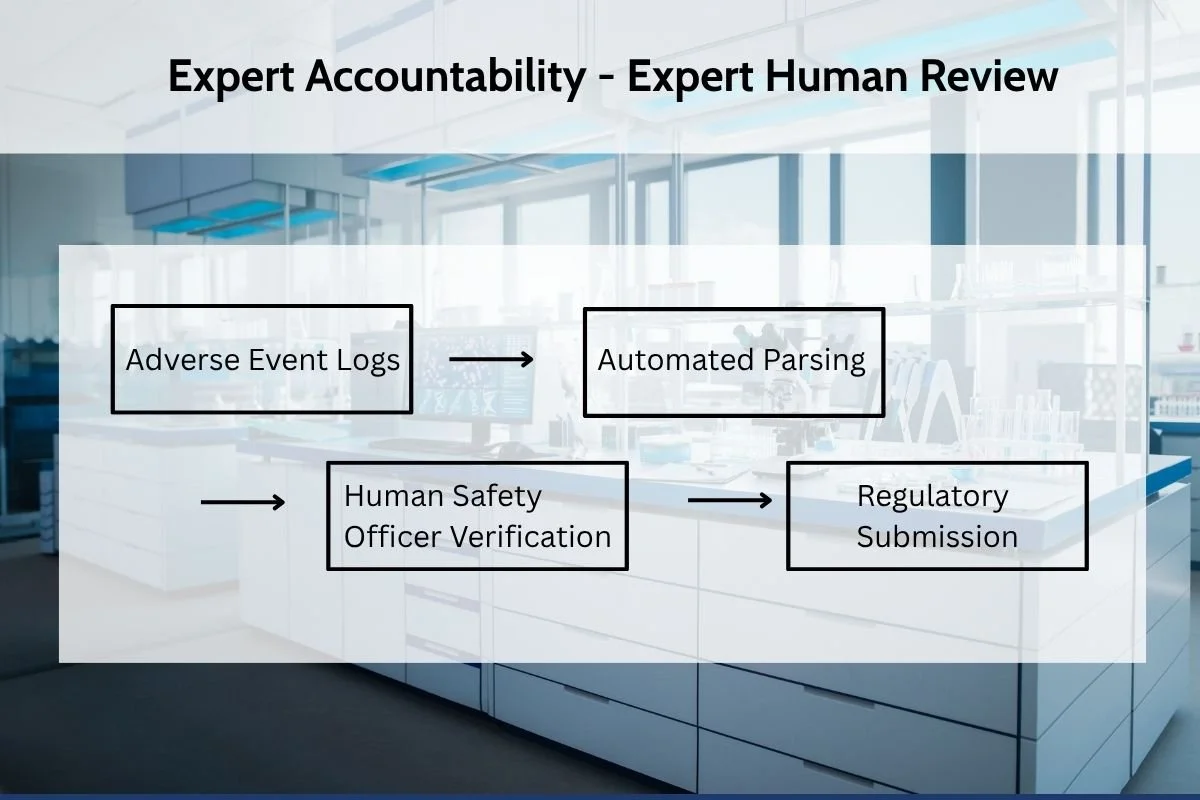
Natural language processing tools scan thousands of unstructured adverse event logs from global post-market databases in minutes, classify reported symptoms, and draft preliminary regulatory notices.
However, software platforms lack causality reasoning:
Confounding Variables: Automated systems struggle to separate an adverse event caused by an investigational therapeutic from one triggered by underlying comorbidities or concurrent patient medications.
Fact Generation Vulnerabilities: Language generation systems drafting compliance reports can inadvertently cite incorrect source data or introduce subtle misinterpretations of medical records.
The Human in the Loop Intervention
Regulatory guidelines worldwide mandate clear chains of expert accountability. Safety officers, medical monitors, and pharmacovigilance leads personally verify every flagged adverse event report.
Human professionals review medical records, evaluate patient histories, and make final causality determinations before submitting reports to health authorities. The tool streamlines data sorting, but expert human review protects patient safety.3
4. Manufacturing Quality Control and Supply Chain Resilience
Pharmaceutical manufacturing functions under strict Current Good Manufacturing Practice regulations, where batch failures carry massive financial and operational costs.
The Algorithm Limits
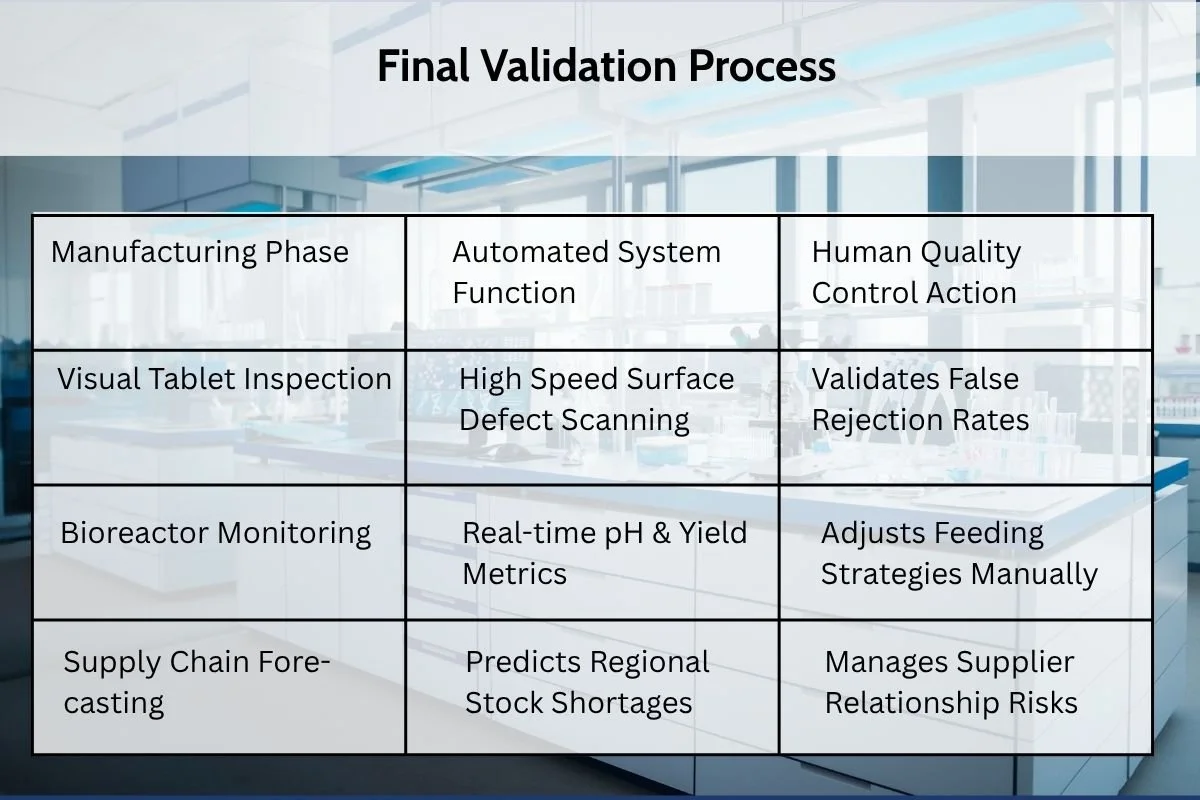
Advanced computer vision models and predictive maintenance engines continuously monitor production lines, tablet consistency, and bioreactor conditions. Despite high precision, these systems present operational limits:
False Positives and Misses: Slight environmental variations, such as humidity changes or conveyor belt vibrations, can lead automated systems to reject good product batches or miss rare structural defects.
Root Cause Blindness: An automated monitor can flag a temperature drift inside a bioreactor, but it cannot analyze multifaceted root causes like raw material purity variances or upstream piping issues.
The Human in the Loop Intervention
Quality control managers and chemical engineers serve as the final validation layer. When operational monitors signal an anomaly, human engineers inspect the equipment, perform physical sample testing, and determine whether to pause or adjust production.
Human expertise prevents unnecessary batch destruction while helping to guarantee that all distributed therapeutics meet rigorous safety and purity standards.
5. Medical Affairs, Commercial Strategy, and Patient Engagement
During post-launch commercialization, biopharma organizations use computational platforms to tailor educational materials, analyze market data, and support patient adherence programs.
The Algorithm Limits
Content generation systems help commercial teams build communication assets efficiently. However, fully automated messaging carries regulatory and relational risks:
Compliance Overreach: Generative tools can unintentionally describe clinical trial results using language that violates strict promotional boundaries regarding off-label usage.
Empathy Deficits: Automated patient support interfaces can offer rigid or improper responses when patients describe complex treatment side effects or emotional distress.
The Human in the Loop Intervention
Medical Science Liaisons, brand managers, and legal teams maintain strict review protocols over all external messaging workflows.
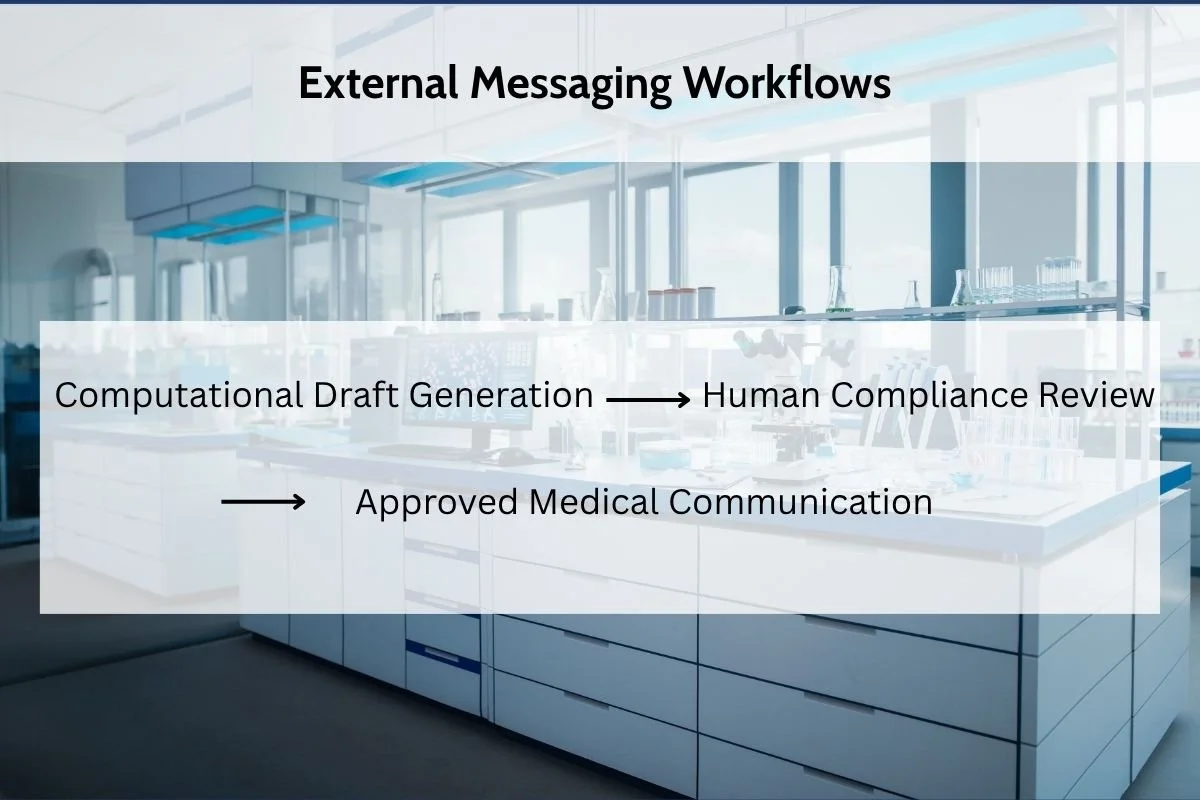
Every educational script, scientific summary, and patient facing asset undergoes careful human verification. Human oversight guarantees regulatory compliance, protects brand trust, and delivers genuine empathy in patient interactions.4
Operationalizing the Human in the Loop Framework
To evaluate how human decision-making integrates across pharmaceutical research and development pipelines, the interactive tool below maps human oversight levels against operational risk tiers.
Four Pillars of Human-Centric Governance
Successfully integrating technology with human expertise requires structured governance across four core areas:
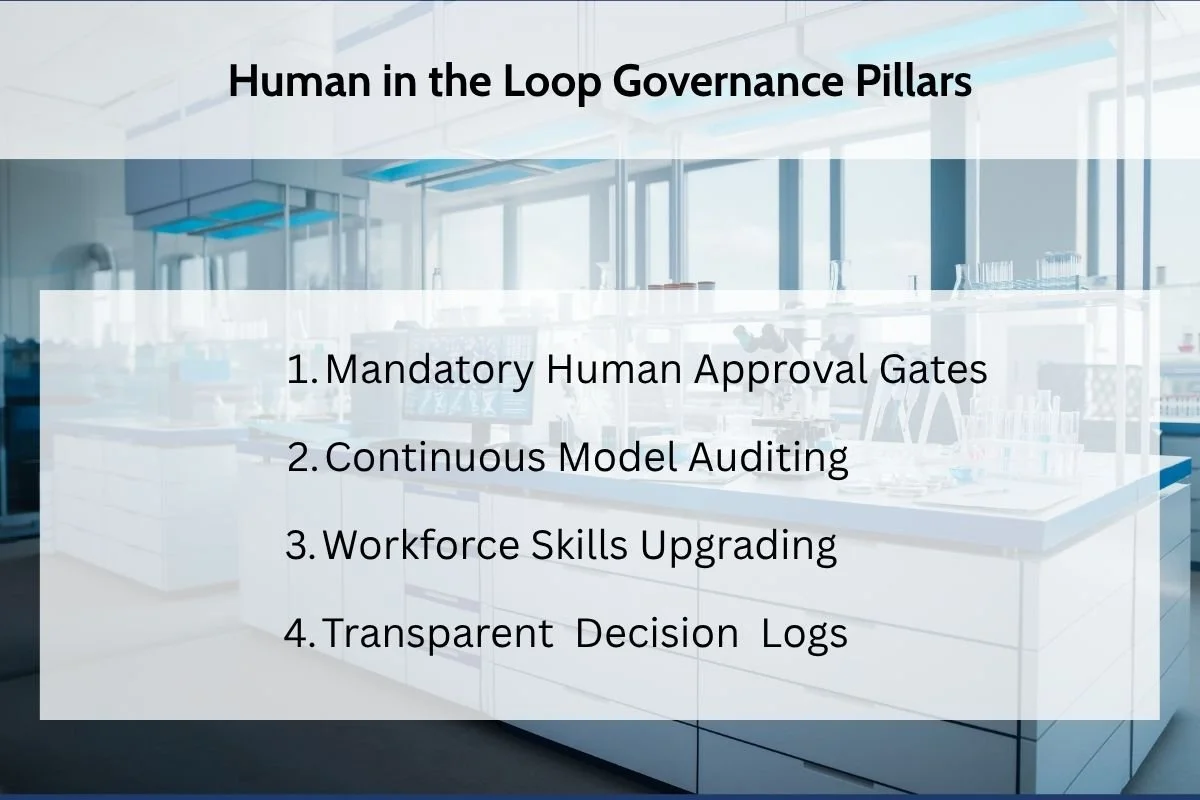
1. Mandatory Human Approval Gates
Define strict operational risk tiers across all automated workflows. Routine tasks like dataset formatting can be highly automated, while critical decisions such as clinical trial protocol shifts, regulatory submissions, and adverse event categorization must require human sign-off.
2. Continuous Model Auditing and Drift Detection
Digital platforms experience performance drift over time as clinical practices, lab equipment, and patient populations change. Human domain experts must regularly review algorithmic predictions against verified biological control samples to identify and correct performance degradation early.
3. Workforce Skills Upgrading
Empowering professionals in the loop requires ongoing technical education. Medicinal chemists, trial directors, and compliance managers need practical computational literacy to understand how systems generate predictions, giving them the confidence to challenge and correct automated output.
4. Transparent Decision Logs
Maintain complete system records tracking both automated recommendations and final human actions. Regulatory agencies increasingly evaluate not only final clinical outcomes, but also the specific rationale provided by human experts during candidate selection and protocol adjustments.
The Human Element as the Ultimate Competitive Advantage
Returning to Dr. Elena Vance in the computational biology lab, her decision to pause, question, and refine the AI-generated molecular candidate saved her organization over eighteen months of futile lab development and millions of dollars in failed animal studies. The deep learning system was invaluable for sifting through millions of theoretical candidates in a few hours, but Dr.Vance's domain expertise converted that raw data into a safe, viable medical discovery.
As biopharma organizations continue to integrate advanced algorithms across discovery, clinical development, manufacturing, and commercialization, leadership must keep a simple truth at the forefront:
Artificial intelligence is an extraordinary microscope, an unprecedented accelerator, and a powerful analytical tool. But it is not a scientist, it is not a physician, and it is not a solution.
The future of biopharma does not belong to companies that attempt to replace human experience with automated systems. It belongs to forward-thinking organizations that surround their brilliant human minds with powerful computational tools, ensuring that clinical judgment, ethical responsibility, and human empathy remain firmly in control of every breakthrough.
Further resources:
For further background on software applications in early computational biology, explore the resources available through the U.S. Food and Drug Administration Science and Research guidance portals.
To review current regulatory frameworks regarding clinical trial integrity, consult the official guidelines provided by the International Council for Harmonization of Technical Requirements for Pharmaceuticals for Human Use
For official updates on drug safety monitoring, visit the European Medicines Agency Pharmacovigilance Overview
To explore international guidelines on digital health communications, review recommendations from the World Health Organization Digital Health Guidelines