
The Mitochondrial Switch: How Silencing MTCH2 Could Redefine Obesity Therapeutics
This week in the Guardrail, we explore groundbreaking research from the Weizmann Institute of Science on MTCH2—a mitochondrial target that could solve the industry's biggest GLP-1 challenge
By Michael Bronfman
August 3, 2026
The metabolic landscape has undergone a massive shift over the past few years. Incretin-based therapeutics, particularly GLP-1 receptor agonists and dual GLP-1 and GIP receptor agonists, have transformed how clinicians treat obesity and metabolic disease. Patients routinely see body weight reductions ranging from 15% to 25%, alongside improvements in glycemic control, cardiovascular risk profiles, and liver fat accumulation.
Yet, as clinical adoption expands, a significant challenge has emerged. Standard calorie restriction combined with incretin therapy causes loss of lean muscle tissue alongside fat mass. In many clinical trials, muscle loss accounts for anywhere between 25% and 40% of total weight reduced. For older adults, individuals with pre-existing sarcopenia, or patients undergoing long-term metabolic treatment, losing lean muscle mass poses genuine risks to metabolic rate, functional mobility, and overall longevity.
To solve this problem, researchers at the Weizmann Institute of Science directed their attention toward fundamental cellular energy dynamics. Their research, published in The EMBO Journal, explores Mitochondrial Carrier 2, a protein commonly known as MTCH2 or Mitch.
By silencing this single protein in human cells, scientists uncovered a cellular mechanism that increases energy expenditure while simultaneously stopping immature preadipocytes from transforming into mature, fat-storing cells.
What Is MTCH2 and Why Does It Matter?
MTCH2 is an outer mitochondrial membrane protein that plays a key role in regulating mitochondrial dynamics, lipid transport, and apoptotic signaling pathways. Mitochondria are constantly changing structures. They fuse together into connected networks or divide into smaller, individual units through a process known as mitochondrial dynamics.
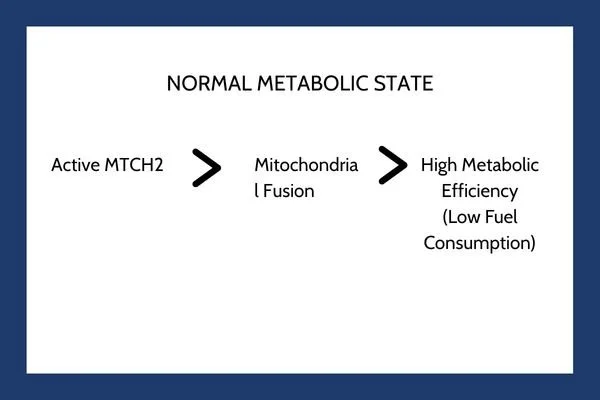
Under normal physiological conditions, MTCH2 acts as a metabolic gatekeeper. It supports mitochondrial fusion and maintains organelle stability. When mitochondria fuse into dense networks, they operate at peak efficiency, generating adenosine triphosphate through oxidative phosphorylation while minimizing energy wastage.
When researchers generated mouse models lacking MTCH2 in previous studies, the animals demonstrated a striking phenotype. They remained lean even when fed high fat diets and exhibited remarkable physical endurance. Translating these findings from animal models to human cellular biology remained a critical milestone.
The Mechanism: Mitochondrial Fission and Energy Demand
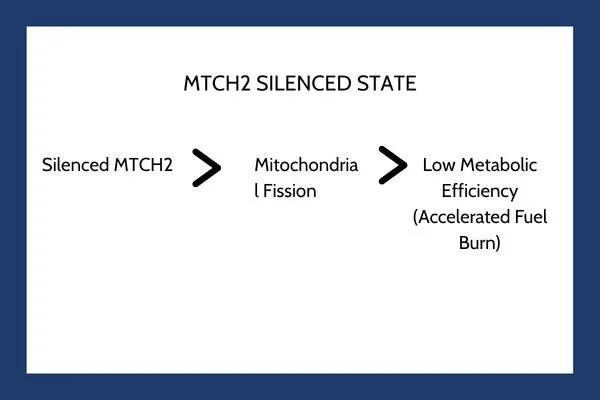
To evaluate whether this phenomenon holds true in humans, the research team used genetic engineering techniques to knock down or silence MTCH2 in human cell lines. The outcome was immediate and distinct.
Without MTCH2, the mitochondrial network loses its ability to fuse efficiently. Instead, the mitochondria separate into smaller, fragmented organelles through fission. This structural alteration significantly impacts cellular bioenergetics.
When mitochondria shift into a fragmented state, their coupling efficiency drops. They produce less ATP per unit of nutrient substrate consumed. To compensate for this sudden energy drop and maintain basic cellular functions, the cell undergoes a energetic scramble. It ramps up metabolic flux, consuming stored triglycerides, fatty acids, and glucose at an accelerated rate.
Key Takeaway: Silencing MTCH2 forces human cells into a continuous state of high metabolic demand. Rather than storing excess nutrients as triglycerides, the cell burns through available fuel sources just to maintain basic energetic equilibrium.
This forced energy expenditure occurs independently of classical uncoupling proteins like UCP1, which drives thermogenesis in brown adipose tissue. Instead, MTCH2 silencing fundamentally alters structural energy transfer within the outer mitochondrial membrane.
Blocking Adipogenesis: Stopping Fat Cells at the Source
The acceleration of metabolic rate is only one half of the story. The study demonstrated a second critical effect: blocking adipogenesis.
Adipogenesis is the multi step differentiation pathway through which precursor cells evolve into mature, lipid laden adipocytes. During normal adipose tissue expansion, precursor cells take up fatty acids, upregulate key transcription factors like PPAR gamma and C/EBP alpha, and accumulate large lipid droplets.
When the researchers silenced MTCH2 in human preadipocytes, the differentiation cascade halted. The cells could no longer execute the metabolic reprograming necessary to build lipid storage vessels.
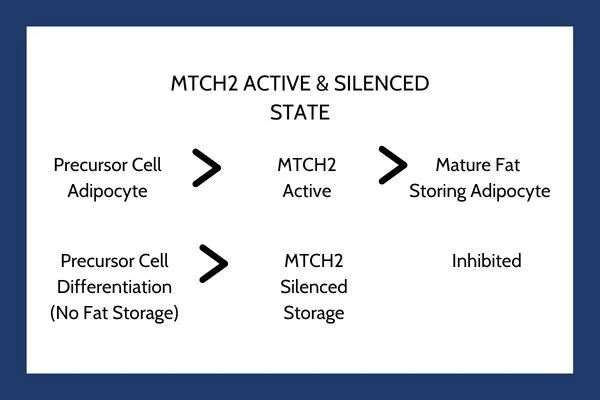
By preventing precursor cells from expanding into fully mature adipocytes, MTCH2 inhibition creates cellular resistance against fat storage. Excess carbohydrates and lipids circulating in the extracellular environment are either oxidized immediately to meet elevated baseline mitochondrial demand or cleared through alternative metabolic pathways.
Comparing Treatment Modalities: Incretins vs. MTCH2 Targets
Understanding where MTCH2 targeted mechanisms fit into the current obesity treatment landscape requires comparing them directly with established incretin therapies.
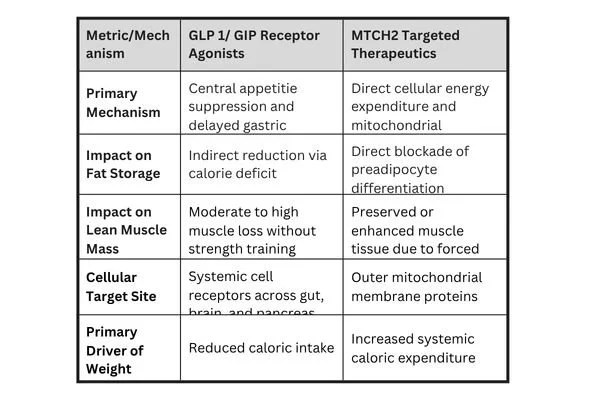
Current GLP-1 therapies act primarily through the central nervous system to reduce hunger and slow digestion, as documented in clinical resources on NCBI PubMed. While effective at reducing overall food intake, a calorie deficit created purely through reduced consumption causes the body to break down both adipose tissue and skeletal muscle protein for gluconeogenesis.
In contrast, an MTCH2-targeted mechanism acts directly at the organelle level. Because the cell demands higher energy flux to sustain itself, skeletal muscle tissue, which is dense with mitochondria, retains its structural requirement for fuel. Animal models lacking MTCH2 exhibited increased endurance capacity, suggesting that mitochondrial fragmentation in muscle tissue encourages fatty acid oxidation without promoting tissue atrophy.
Addressing the Lean Muscle Loss Dilemma
Preserving skeletal muscle during weight reduction is one of the most pressing goals in modern pharmaceutical development. Skeletal muscle is not simply a structural tissue; it is a major site of insulin-mediated glucose disposal, amino acid storage, and basal metabolic output.
When patients lose significant muscle mass during rapid weight loss:
Resting metabolic rate drops sharply, increasing the likelihood of weight regain once therapy stops.
Insulin sensitivity gains can plateau, as muscle tissue accounts for up to 80% of postprandial glucose uptake.
Physical strength and bone mineral density decrease, raising long-term cardiovascular and musculoskeletal risks.
By shifting the primary therapeutic driver from overall caloric restriction to targeted cellular energy expenditure, MTCH2 pathways offer a potential strategy for selective lipid reduction. Because the mechanism directly blocks adipogenesis while driving lipid burning within existing cells, it spares structural proteins needed for skeletal muscle integrity.
Challenges and Considerations for Drug Development
Translating cellular discovery into safe, orally bioavailable or injectable therapeutics presents significant pharmacological challenges. Because MTCH2 is expressed across multiple tissue types, drug developers must address several critical factors:
1. Tissue Specificity and Delivery Mechanisms
MTCH2 exists in cardiac, hepatic, renal, and central nervous system tissues. Inducing indiscriminate mitochondrial fragmentation across all organs could disrupt tissue function, particularly in high-demand organs like the heart. Future therapeutic strategies may require targeted delivery vehicles, such as antibody drug conjugates or lipid nanoparticles designed specifically for white adipose tissue and skeletal muscle.
2. Small Molecule Modulation versus Complete Knockdown
In genetic engineering experiments, researchers completely silence or knock out the target gene. In clinical medicine, total inhibition of an outer mitochondrial membrane protein may trigger unwanted cellular stress or apoptotic cascades over time. Drug discovery efforts will likely focus on allosteric modulators that partially reduce MTCH2 activity or disrupt specific protein-protein interactions without abolishing mitochondrial stability entirely.
3. Monitoring Systemic Biomarkers
Increasing baseline energy expenditure generates metabolic byproducts, heat, and reactive oxygen species. Clinical protocols evaluating MTCH2 modulators will need to monitor serum lactate levels, systemic inflammatory markers, mitochondrial health indicators, and body temperature regulation during early-phase safety trials.
Future Outlook for Next Generation Anti Obesity Therapeutics
The identification of MTCH2 as an energy expenditure switch highlights a fundamental shift in metabolic research. While first-generation anti-obesity drugs focused heavily on central nervous system appetite regulation, next-generation approaches aim to directly modify cellular bioenergetics and tissue composition.
Combinational approaches may represent the future of metabolic medicine. Combining a low-dose GLP-1 receptor agonist to manage appetite with a tissue-targeted MTCH2 modulator could allow clinicians to achieve profound lipid reduction while entirely preventing lean muscle loss.
If your organization is ready for the next frontier of metabolic drug development a. to navigate complex R&D landscapes, with precision strategy and deep scientific foresight, contact Metis Consulting Services today
