

Writing for Human and AI Reviewers: The New Way to File
The rise of automated FDA AI reviewers means mastering the balance between machine-readable data and clear medical storytelling. It is no longer optional—it is the key to avoiding costly filing delays.

The rise of automated FDA AI reviewers means mastering the balance between machine-readable data and clear medical storytelling. It is no longer optional—it is the key to avoiding costly filing delays.
By Michael Bronfman
May 11, 2026
The world of medicine is changing fast. For decades, pharmaceutical companies followed a simple path: run a study, write a report, and send it to the Food and Drug Administration (FDA). The “audience” was always a group of human scientists. But in 2026, the rules have shifted. Today, when a company submits a new drug application, the first “eyes” on the document might not be human at all.
Smart software and advanced data tools now help regulators look through thousands of pages in seconds. This means that if you are writing a regulatory submission, you are no longer just writing for a doctor or a chemist. You are writing for a machine, too. This double audience requires a whole new way of thinking about how we present science.
Why This Matters Now
The FDA recently released new rules about how companies can use smart technology in their filings. They made a big distinction between “low risk” and “high risk” uses. This matters because it tells companies where they need to be the most careful and spend the most time.
High Risk: If a computer program is used to select which patients receive a drug, determine the dose, or identify safety signals, the FDA looks at it very closely. This is because these tasks directly impact whether a drug is safe for people. This is the area of high scrutiny.
Low Risk: If the technology is just helping with internal office work, scheduling meetings, or organizing files, the requirements are much lighter.
Because of these new rules, companies have to change how they communicate. They have to be clearer and more organized than ever before. If a machine cannot understand your report, it might flag it as a mistake, even if the science is perfect. A flag from a machine can lead to months of delays, costing companies millions of dollars and keeping medicine away from patients who need it.
Writing for the Machine: What Does It Mean?
Machines do not read as we do. They do not look for beautiful prose or clever metaphors. They do not get impressed by fancy vocabulary. Instead, they look for patterns, data points, and absolute consistency. To get a submission through a machine review without any red flags, writers must use a front-loading strategy.
Front Loading Clarity
“Front loading” means putting the most important information at the very beginning of every section. Instead of building up to a conclusion like a mystery novel, you state the conclusion first.
Old way: After reviewing 500 patients over 6 months and checking their blood pressure daily, we found that the drug worked.
New way: The drug reduced blood pressure by 15% in 500 patients. This conclusion is based on a six-month study where…
This helps the machine categorize the information instantly. It creates a “map” for the software to follow.
Avoiding Inconsistencies
One of the biggest reasons a filing gets flagged today is a data mismatch. Imagine you say a drug is 90% effective on page 10, but a table on page 400 says 89.9%. A human might realize it is simply a matter of rounding up and continuing reading. A machine sees a red flag and stops.
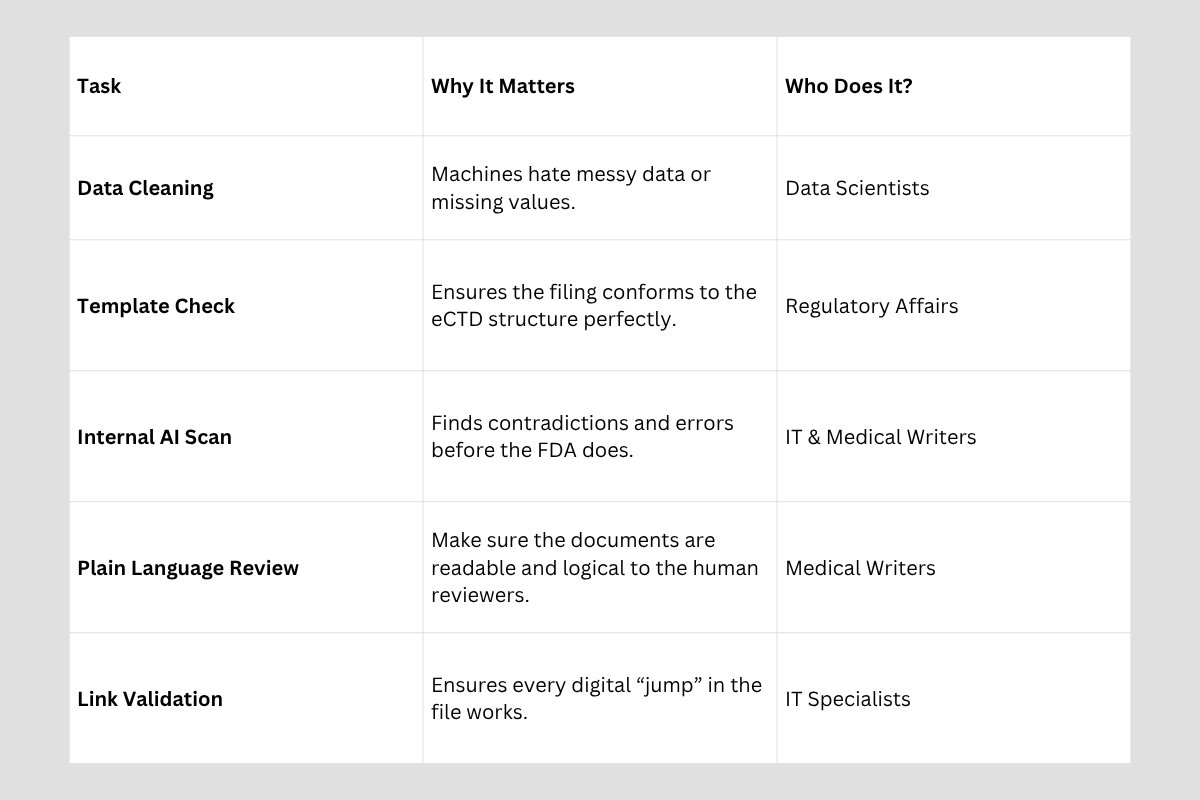
To prevent this, companies are now doing AI readiness reviews. This is a step where the company runs its own software on the document before sending it to the government. They look for the same things the FDA’s machines will look for:
Terminology: Using the exact same word for a concept every single time. Do not call it “the medicine” in one spot and “the compound” in another if you want the machine to track it easily.
Cross References: Making sure every link to a chart or table actually works and points to the precise data.
Structure: Following the eCTD format (electronic Common Technical Document) perfectly, so the software knows where to look for information.
The Human Factor: Keeping the Science Real
Even though machines are doing the heavy lifting, humans still make the final decision. A doctor at the FDA still needs to trust that the drug works. This creates a double challenge. You have to be technical enough for a computer but clear enough for a person.
The Problem with “Robot Speak”
Sometimes, when people try to make things easy for computers, the writing becomes stiff and hard to follow. This is a mistake. If a human reviewer gets confused ot just bored, they may start to doubt the work. The best regulatory writing today uses plain language principles.
Short Sentences: Long, winding sentences may confuse both people and software. Aim for 20 words or fewer.
Active Voice: Saying “The study showed…” instead of “It was shown by the study…” makes the facts stand out and defines who is responsible for the action.
Bullet Points: Lists are easy for machines to scan and for busy human reviewers to read quickly during a long workday.
High Scrutiny Areas: Where Accuracy Counts Most
The FDA Guidance for Industry focuses heavily on a few specific areas. If your submission uses advanced tech for these, expect the highest level of checking:
1. Patient Stratification
This is a fancy way of saying that patients are being sorted into groups. If a computer picks which patients will benefit most from a drug based on their DNA or history, the FDA wants to know exactly why. You cannot just say “the computer said so.” You have to explain the logic in a way a human can verify.
2. Dose Optimization
Finding the right amount of medicine to give someone is a science. If you use a machine to find that “perfect dose,” you must prove the machine isn’t making a mistake that could hurt someone. This requires showing the “math” behind the machine’s decision.
3. Real World Data Analysis
Sometimes companies analyze health records from millions of people to see how a drug works in the real world. This is a mountain of data. Machines are great at this, but they can also find patterns that don’t actually exist (called “noise”). Your report must explain how you ensured the data was clean and the patterns were genuine.
4. Safety Signal Detection
This is about finding side effects. If a machine is the first thing to “notice” a side effect in a clinical trial, the documentation must show how that information was passed to human doctors for a final check. The human must always be in the loop.
The Importance of Pre-Submission Checks
In the old days, a team would proofread a document for typos and then send it off. In 2026, that is not enough. The “Internal AI Readiness Review” is now a required step for any serious pharma company.
This process involves using tools to “stress test” the document. For example, the team asks:
“Can a computer find the primary endpoint in less than one second?”
“Are there any hidden characters or weird formatting that will break the FDA’s software?”
According to Clinical Leader experts, companies that skip this step often face “Refusal to File” letters. This means the FDA will not even look at the science because the document itself is too messy for their tools to handle.
The Role of the Medical Writer in 2026
The job of a medical writer has changed. It is no longer just about writing; it is about information architecture. A writer today must understand how data flows from the lab into a table and convey that with a paragraph.
They act as a bridge. On one side, they have the data scientists who talk in code and numbers. On the other side, they have the regulators who want to ensure public safety. The writer must translate complex data into a structured format that satisfies both software scanners and human doctors. This requires a deep understanding of the eCTD structure and the ability to write with mathematical precision.
How to Prepare: A Practical Checklist
If you are working on a pharma team, you cannot wait until the last minute to think about these things. Preparation starts months before the “submit” button is pushed.
Ethics and Transparency: The “Explainable” Requirement
One thing a machine cannot do is be ethical. It cannot think about the spirit of the law or the “heart” of a patient. That is why transparency is the biggest buzzword in 2026.
When you use a machine to help write or analyze a filing, you must be honest about it. You must show the pathway the machine followed to reach its answer. This is often called Explainable AI. If a regulator can see the steps, they can trust the result. If the process is obscured, a “black box” in which no one knows how the answer was derived, the FDA will likely reject it.
Bridging the Gap
Writing for both human and machine reviewers is a new skill, but it is one that every professional in the pharmaceutical industry needs to learn. By focusing on structure, consistency, and clear language, companies can get life-saving drugs to patients faster.
The goal should not be to let the machines take over the process. Instead, the goal is to use the machines to make our work more accurate and organized. This allows FDA staff to spend less time looking for errors and more time examining the science. When we write for both audiences, everyone wins—especially the patients waiting for new treatments.
For more information on the technical side of these filings and to stay updated on new research, you can explore the Wiley Online Library.
Key Takeaways for understanding
Machines are now helping regulators read drug reports. Because of this, we have to write in a way that doesn’t confuse the software.
Consistency is king. If you use different words for the same thing or have small math errors, the machine will flag it as a big problem.
The FDA cares most about “High Risk” tasks. If a computer is used to determine a patient’s dose or identify safety issues, the rules are much stricter.
Clear writing helps humans and computers. Short sentences, bullet points, and putting the main point first (front loading) make the report better for everyone.
Always do a “practice run.” Companies now use their own software to check their reports for mistakes before sending them to the government.
Don’t let a technical red flag stand between your breakthrough and the patients who need it most. Contact Metis Consulting Services today to ensure your next submission is AI-ready, human-approved, and built for success.

How the FDA is speeding up Psychedelic Therapies with National Priority Vouchers
How the FDA is speeding up Psychedelic Therapies with National Priority Vouchers

By Michael Bronfman
May 4, 2026
This week in the Guardrail, How groundbreaking FDA policy shifts are accelerating the path to market for psychedelic-assisted therapies. New incentive structures for mental health may finally bridge the gap between clinical innovation and patient access.
Mental health care is undergoing a dramatic transformation. For decades, the standard treatment for depression and anxiety relied on the same types of pills—some effective, many not. Now, government and scientific attention are rapidly shifting to "psychedelic" medicines like psilocybin (from magic mushrooms) and methylone, which provide prospects for those left behind by previous treatments.
Just this month, in April 2026, the Food and Drug Administration (FDA) made a historic move. They awarded special rewards, called National Priority Vouchers, to three groups working on these new treatments. These vouchers are like a "fast pass" at a theme park. They allow a company to jump to the front of the line when the FDA checks its new drug. This could mean life-saving medicine reaches patients months or even years earlier than usual.
What is a National Priority Voucher?
To understand why this is a big deal, we have to look at how drugs get approved. Normally, it takes the FDA a long time to review all the data from a clinical trial. They want to make sure a drug is safe and that it actually works. This process can take ten months or more.
A Priority Review Voucher (PRV) changes the rules. It tells the FDA they must complete their review in about 6 months, rather than 10. Recently, a new type of voucher, the Commissioner’s National Priority Voucher (CNPV), was created. These were specifically designed to help fight the mental health crisis.
In April 2026, President Trump signed an executive order to help veterans and other people struggling with mental illness. He told the FDA to use these vouchers to speed up the review process for drugs with "breakthrough" potential.
Let's look at who is driving this change and receiving these important vouchers.
Three major groups received these special vouchers on April 24, 2026:
Compass Pathways: They are testing a synthetic version of psilocybin called COMP360 for people who have "treatment-resistant depression." This means the patients have tried at least two other pills that did not work.
Usona Institute: A non-profit group. They are using psilocybin to treat "major depressive disorder," which is a severe form of sadness that makes it hard to live a normal life.
Transcend Therapeutics (now part of Otsuka): They are working with a drug called methylone to treat Post Traumatic Stress Disorder (PTSD). This is especially important for military veterans who have seen combat.
Why These Drugs Are Called "Breakthroughs"
The FDA does not give these vouchers to just any drug. A medicine must first earn a Breakthrough Therapy Designation. This title is given when early tests show that a drug might be much better than what we already have.
Psychedelic therapies are different because they aren't simply a pill you take every morning. Usually, a patient takes the medicine once or twice in a doctor's office while a trained therapist guides them through the experience.
Breaking the Cycle of Depression
For people with "treatment-resistant depression," life can feel like being shut in a dark room with no door. Standard drugs often simply dull the pain. Researchers compare psychedelics to a "reset button" for the brain, helping it build new connections.
In recent Phase 3 trials—the final step before a drug is sold—Compass Pathways found that some patients felt better within a single day. Those effects lasted for six months for many people. This is a huge leap forward compared to older drugs that take weeks to start working.
The Big Goal: Helping Our Veterans
One of the main reasons the government is pushing so hard for these vouchers is to help veterans. Many soldiers come home with PTSD. They might have nightmares, feel angry, or feel very alone. Sadly, current treatments do not help everyone, and suicide rates among veterans are very high.
The government is now using every tool available to fix this. By giving vouchers to companies like Transcend and Usona, they are saying that mental health is a national priority.
The new rules also talk about the Right to Try Act. This law allows patients who are very sick to try experimental drugs before the FDA fully approves them. This is being expanded to include psychedelic compounds so that people who have no other options can get help now.
How the Vouchers Work Behind the Scenes
You might wonder why a company needs a "voucher" to go faster. Isn't every drug important? The truth is that the FDA is very busy. They have thousands of applications to read.
When a company uses a voucher, they also have to pay a large fee. In 2025, that fee was about $2.5 million. This money helps the FDA hire more staff so they can review papers faster without slowing down other important drugs, such as those for cancer or heart disease.
One common question is about whether these vouchers themselves can be sold, as has happened in other programs.
In the past, certain types of vouchers could be resold—sometimes for over $100 million. Typically, a small company would be awarded a voucher for developing a rare disease drug and then sell the voucher to a large company, using the funds to support further research.
However, the new Commissioner’s National Priority Vouchers (CNPVs), given specifically for psychedelic treatments, are different. Reports indicate that these particular vouchers cannot be sold; only the company that earned them can use them. This rule makes sure that the experts who did the hard work are the ones who bring the medicine to market and prevents the resale that happened with other FDA voucher types in the past.
Going forward, it’s important to consider the following steps for these therapies and the wider mental health environment.
Even with a fast pass voucher, the work is not over. The companies still have to finish their big Phase 3 studies. They have to prove that the drug is safe over a long period of time.
The FDA is also expected to release new "final guidance" very soon. This will be a rulebook for how all future psychedelic drugs should be tested. It will cover things like:
How many therapists need to be in the room?
How to keep the patients safe during the "trip."
How to measure whether the drug is actually improving the patient's life.
A Timeline for Change
If everything goes well, we might see the first fully approved psychedelic medicine by the end of 2026 or early 2027. Because of the vouchers, that date moved up by at least four months. In the world of mental health, four months can save thousands of lives.
Common Questions About the New Vouchers
Are these drugs legal now?
No. These drugs are still "investigational." That means they are only legal to use in special research studies or through the "Right to Try" program for very sick people. They are not yet available at a local pharmacy.
Does a voucher guarantee approval?
No. A voucher merely guarantees a faster review. The FDA can still say "no" if it thinks the drug is unsafe or the data are not good enough. For example, a group called Lykos tried to get an MDMA drug approved for PTSD, but the FDA said no because they needed more data. The voucher just speeds up the "yes" or "no" response.
Why is this happening in 2026?
The mental health crisis has reached a point where the government has decided to take bold action. By using executive orders and creating new voucher programs, leaders are trying to solve the problem faster than the old system allowed.
A Future of Promise
The use of National Priority Vouchers for psychedelic therapies is more than merely a boring business move. It is a signal that our society is ready to think differently about mental health. We are moving away from daily pills that only mask symptoms and moving toward treatments that might actually heal the brain.
By giving these "fast passes" to scientists, we are giving precedence to the millions of people—including our brave veterans—who have been waiting for a breakthrough. The road is still long, and there are many rules to follow, but for the first time in decades, the finish line is in sight.
The year 2026 will likely be remembered as the year the "psychedelic revolution" finally got the go-ahead from the highest levels of government. It is an exciting time for science, and an even more hopeful time for patients.
Important Links to Follow the News
If you want to keep track of these changes, here are some active websites where you can find the latest updates:
FDA Press Announcements https://www.fda.gov/news-events/fda-newsroom/press-announcements – This is where the government officially announces new vouchers and drug approvals.
ClinicalTrials.gov – You can search for "psilocybin" or "PTSD" to see what studies are happening near you.
Psychedelic Alpha – A news site that tracks the business and law side of these new medicines.
Usona Institute – The website for the non-profit group that just received a national priority voucher.
Compass Pathways – Information on the Phase 3 trials for treatment-resistant depression.
Regulatory changes for psychedelic medicine are moving faster than ever, and navigating the complexities of FDA vouchers and breakthrough designations requires expert precision. Ensure your company is positioned at the front of the line—contact Metis Consulting Services today. The strategic guidance you need to bring life-changing healing to those who need it.

Ethical Research and the Importance of Quality
This week in the Guardrail: Rigorous quality oversight isn't just a regulatory hurdle; it is the ultimate expression of respect for the safety and dignity of the patient. Read more about Ethical Research and the Importance of Quality in this week’s Guardrail blogpost.

This week in the Guardrail: Rigorous quality oversight isn't just a regulatory hurdle; it is the ultimate expression of respect for the safety and dignity of the patient. Read the article below.
By Michael Bronfman
The world of medicine relies on a simple promise. That promise is that every pill or treatment you take has been tested for safety and truth. This process is called clinical research. Behind every successful medicine is a long line of scientists and doctors. They work hard to ensure the data they collect is accurate. This is where the idea of quality comes into play. Quality is not just about doing a good job. In the world of pharmaceutical research, quality is the shield that protects the volunteers in medical studies. It ensures that their contribution leads to safe cures for everyone else.
What Does Quality Mean in Medical Studies
When we talk about quality in a lab or a hospital, we are talking about a set of rules. These rules are known as Good Clinical Practice. These standards make sure that the results of a study can be trusted. If a study is done poorly, the data might be wrong. If the data is wrong, then a dangerous medicine might be approved. Or a helpful medicine might be thrown away by mistake.
Quality starts with a plan. This plan is called a protocol. It lists every step the researchers will take. Following the plan exactly is the only way to keep the research ethical. When researchers cut corners, they put people at risk. High-quality research means being honest about every detail from start to finish.
Why We Must Protect the People in the Study
Clinical trials need human volunteers. These people are often called participants. They are the most important part of the research process. Without them, we would have no new ways to fight diseases. Ethical research means treating these people with respect and keeping them safe.
Quality systems are built to monitor the health of these volunteers. If a participant gets sick, the researchers must record it immediately. They must also decide if studying medicine caused the problem. This is a key part of the FDA safety guidelines that all drug companies must follow. Protecting the participant is the highest priority in any high-quality study.
The Role of Informed Consent
One of the most important parts of ethical research is informed consent. This means that a person knows exactly what will happen to them during a study before they agree to join. Quality control experts check the forms that people sign. They make sure the language is easy to understand.
A person should never feel forced to join a study. They should know the risks and the benefits. If a study is of poor quality, the researchers may not adequately explain the risks. This is a major ethical failure. By maintaining high-quality standards, we ensure that every volunteer makes a truly free choice.
Keeping Data Honest and Clear
In research, data is the evidence. It proves whether a drug works. If the data is messy or lost, the entire study fails. Ethical research requires data integrity. This means the numbers cannot be manipulated to make them look better than they are.
Companies use quality audits to assess scientists' work. They look at the original records to see if they match the final reports. If someone makes a mistake, it must be noted clearly. Hiding mistakes is unethical. When quality is high, the data is a clear mirror of what actually happened during the trial. This is essential for organizations such as the World Health Organization, which sets global health standards.
How Quality Systems Prevent Errors
Research errors can be very expensive and dangerous. A small dose error can lead to a serious problem for a patient. Quality management systems act like a safety net. They use checks and balances to catch errors before they cause harm.
For example, if a scientist is supposed to check a blood sample at a specific time, the system logs that event. If the scientist forgets, the system sends an alert. These tools help maintain a high level of accuracy. Accuracy is a form of respect for the science and the patients.
The Link Between Ethics and Quality
It is impossible to have ethical research without high quality. Think of it like building a house. Ethics is the reason you want the house to be safe for the family living there. Quality is the set of strong materials and correct measurements you use to build it. If you use weak wood, the house might fall down. In pharma research, if you use poor quality, the ethical foundation crumbles.
Regulators like the European Medicines Agency look for this link. They want to see that companies care about the truth as much as they care about profit. They ensure that every company follows the same ethical path. You can find more about these standards on the European Medicines Agency website
The Future of Quality in Pharma
Technology is changing how we do research. We now use computers and artificial intelligence to track data. This can make quality even better. It allows us to see patterns faster. We can spot safety issues much earlier than we could in the past.
Even with new tools, the human element remains the most vital part. Doctors and nurses must still look their patients in the eye. They must remain committed to the truth. Quality is a culture that starts with people. It is a commitment to doing things the right way, even when no one is watching.
How to Tell if a Study is Ethical
If you are thinking about joining a study or just want to learn more, there are things to look for.
Does the study have an Institutional Review Board (IRB)? This is a group that reviews the ethics of the study.
Is the study listed on official sites like ClinicalTrials.gov? An official listing means the study is in compliance with legal quality standards.
Are the researchers willing to answer all your questions? Openness is a sign of high quality.
Final Thoughts on Quality and Ethics
Quality in pharmaceutical research is about more than just paperwork. It is about the lives of real people. Every time a new medicine reaches the pharmacy, it is the result of thousands of hours of careful work. This work must be done with the highest level of integrity.
When we focus on quality, we protect the volunteers. We protect the scientists. Most importantly, we protect the millions of people who will use the medicine in the future. Quality is the only way to ensure that medical progress is also ethical progress. We must continue to demand high standards from every drug company and every research lab. This is how we build a healthier and safer world for everyone.
When patient safety is your North Star, compliance becomes your greatest competitive advantage. Contact Metis Consulting Services today to build a culture of quality that honors your participants and safeguards your path to market.
Active Web Links
FDA Clinical Trial Basics: https://clinicaltrials.panfoundation.org/
WHO Ethical Standards: https://www.who.int/teams/health-ethics-governance/governance/research
EMA Good Clinical Practice: https://www.ema.europa.eu/en/human-regulatory-overview/research-development/compliance-research-development/good-clinical-practice
Official Clinical Trials Registry: https://clinicaltrials.gov/

GLP and GCP: How the FDA and EPA Watch Over Science
Two of the most important sets of rules are called GLP and GCP. In 2026, the two main government agencies responsible for these rules, the Food and Drug Administration (FDA) and the Environmental Protection Agency (EPA), are working together more than ever before. Re: FDA & EPA Oversight.

This week in the Guardrail…
We explore how federal oversight is shifting standards in 2026, making rigorous data integrity the new baseline for every laboratory and clinic.
By Michael Bronfman
The world of making new medicines and chemicals is a very busy place. Every day, scientists are working in labs and clinics to find the next big cure or a safer way to clean our homes. Because these products can affect our health and the planet, the government has very strict rules to ensure everything is done correctly. Two of the most important sets of rules are called GLP and GCP. In 2026, the two main government agencies responsible for these rules, the Food and Drug Administration (FDA) and the Environmental Protection Agency (EPA), are working together more than ever before. This “shaking out” of the rules is changing how companies operate.
What Do These Letters Mean
To understand the future of science, you first have to know what these abbreviations stand for. They are like a specialized language for safety and honesty.
GLP stands for Good Laboratory Practice. These rules are for the early stages of research. This is the work that happens in a lab with test tubes, plants, or animals before a human ever touches the product. The Environmental Protection Agency uses these rules to ensure that a new pesticide or powerful cleaner will not harm the environment or the people using it.
GCP stands for Good Clinical Practice. These rules start when the research moves into a clinic and involves human volunteers. The Food and Drug Administration uses GCP to ensure that participants in medical studies are safe and that the results are truthful.
The FDA and the EPA Joining Forces
In the past, these two agencies mostly stayed in their own separate worlds. If a company were making a heart medicine, they would talk to the FDA. If they were making a new bug spray, they would talk to the EPA. But today, many new products fall into both categories. For example, a special soap that kills germs on your skin might be considered both a medicine and a chemical.
Because of this, the FDA and EPA are now sharing their notes. If an EPA inspector finds that a lab is messy or that the scientists are not recording their results correctly, they report it to the FDA. This means companies can no longer be “half good.” They have to follow the rules perfectly for both agencies. This coordination ensures that, no matter what kind of product is being made, the public is protected by the highest standards.Official Federal Register : How these agencies work together
Why Honesty Is the Only Policy
The main goal of both GLP and GCP is to ensure data integrity. Data is just a fancy word for the information and results gathered during an experiment. If a scientist says that a drug worked on ten people, the government wants to see the actual signatures and blood test results to prove it.
If a company is caught lying about its data, it can be fined millions of dollars. They might even be banned from ever making products again. This is why risk management is so important during the middle stages of a study. If a company finds a minor mistake in its lab records, it needs to fix it immediately. Waiting until later to “clean up” the paperwork is a huge risk that can lead to a total failure when the FDA or EPA comes to visit.
Protecting the People in the Studies
While GLP protects the science in the lab, GCP protects the people in the clinics. Every person who joins a clinical trial is a volunteer. They are doing something brave to help others. GCP rules ensure that these volunteers are treated with respect.
Under these rules, every volunteer must sign a form acknowledging the risks. This is called informed consent. The doctors must also closely monitor the volunteers for any side effects. If a patient experiences a headache or dizziness, it must be recorded in the official files. TheNational Institutes of Health provides extensive information on how these rules help keep people safe in medical research.
The Quality Control Revolution
In 2026, many companies are hiring specialized teams just to ensure quality. These teams are like the “referees” of science. They do not do the experiments themselves. Instead, they monitor the other scientists to ensure they follow all GLP and GCP rules.
They check that lab machines are properly calibrated. They check to ensure that every signature on a form is genuine and dated correctly. This might sound like a lot of extra work, but it saves the company from failing an inspection. When a company has a high “quality score,” the FDA and EPA can trust their results much more easily. Organizations like theSociety of Quality Assurance help train these specialized workers to stay up to date on the latest rules.
Using Technology to Stay Safe
Technology is making it easier for the FDA and EPA to do their jobs. In the old days, inspectors had to look through thousands of paper files. Now, most of the data is digital. This allows the government to look at the data in real time.
If a lab in California runs a test, an official in Washington, D.C., can see the results almost instantly. This helps catch mistakes before they become big problems. It also makes it harder for anyone to change their results later to make a drug look better than it really is. This transparency is a big part of why the “shake out” between the two agencies is happening so fast. Digital tools make it impossible to hide in the shadows.
The Global Impact of These Rules
Australia, Europe, and the United States all have their own versions of these rules. However, they are all starting to look very similar. This is good news for the public. It means that a drug tested in Australia can be sold in America as long as it follows the same high standards of GLP and GCP.
When countries agree on the rules, medicines can travel around the world much faster. This helps people in every country get the help they need without waiting years for additional testing. TheWorld Health Organization works to help all countries follow these same high standards for health and safety.
Education Is the Key
For these rules to work, every person in the pharmaceutical industry needs to be educated. It is not just the boss's job. Even the person cleaning the lab or the nurse at the clinic needs to understand why the rules matter.
Education helps people understand that following the rules is about more than just avoiding a fine. It is about making sure that the medicine your grandmother takes, or the soap you use on your children, is 100 percent safe. When everyone knows the “why” behind the rules, they are much more likely to follow them correctly every single day.
Risk Management and Quality Systems
Modern pharmaceutical companies use a Quality Management System (QMS) to track everything. A QMS is like a giant digital brain that stores all the company's rules and records. It helps with risk handling by flagging errors the moment they happen.
In 2026, risk management strategies are no longer just about fixing problems. They are about predicting them. By using clinical data management tools, a biotech firm can detect whether a machine is starting to wear out or whether a lab is experiencing too many small errors. This type of risk management planning helps prevent major disasters that lead to FDA warning letters.
The Role of REMS in Safety
Another way the FDA keeps people safe is through REMS, which stands for Risk Evaluation and Mitigation Strategies. These are extra safety programs for drugs that might be dangerous if not used exactly right. For example, some medicines require a patient to get a blood test every month. TheFDA REMS website tracks these programs to ensure drug companies are doing their part to manage risk.
Final Thoughts on the Future of Quality
The “shaking out” of rules between the FDA and the EPA is a positive step for everyone. It means that science is becoming more open and more honest. Companies are learning that they cannot take shortcuts during any stage of research.
By following the rules of GLP and GCP, we ensure that the future of medicine is bright. We can trust the products we buy because we know the government is watching and the scientists are being careful. Quality is not just a set of letters; it is a promise to the public that their safety is the most important thing of all. Don’t wait for a problem to appear before you start being careful. Start with quality on day one and the rest of the journey will be much smoother for everyone.
Frequently Asked Questions: GLP, GCP, and Regulatory Compliance
What is the main difference between GLP and GCP?The biggest difference is when they are used. GLP is for the preclinical stage, which is work done in a lab on animals or cells. GCP is for the clinical stage involving human volunteers.
Why does the EPA care about laboratory rules?The EPA ensures that chemicals like weed killers do not pollute our water. They use GLP to ensure companies are honest about chemical safety. You can find guidelines on theEPA Compliance Monitoring page.
Can a company fail a trial if they follow the science but miss the paperwork?Yes. In the eyes of the FDA, if a test was not documented correctly, it never happened. “Clean data” is just as important as the medicine itself.
What happens during an FDA or EPA inspection?Inspectors check original notebooks, computer logs, and even equipment logs. They want to see a clear trail from the study's start to the final report.
How does Risk Mitigation help with these rules?It means finding small mistakes before the government does. Fixing a mistake early in a study costs much less than fixing it later, when thousands of people are involved.
Where can I stay updated on these changing rules in 2026?The best place to watch for updates is theFDA Voice blog. This site tracks how the agencies are joining their rules for digital data. https://www.fda.gov/news-events/fda-newsroom/fda-voices.
The Pre-Inspection Compliance Checklist
When an inspector arrives, they look for a “culture of quality.” If you are preparing for an audit in 2026, here are the top ten things you must have ready.
Item
Description
1. The Master Schedule
A list of every study that has happened in your lab.
2. Current SOPs
Proof that your team is using the newest versions of your rulebooks.
3. Training Logs
Proof that every person was taught how to do their job before starting.
4. Equipment Records
Logs showing that every scale and fridge is checked regularly.
5. Chain of Custody
A record of who touched a sample at every single minute.
6. Raw Data
Original handwritten notes or machine printouts.
7. QA Reports
Reports from your own internal “referees.”
8. CAPA Plans
Records showing how you found and fixed past mistakes.
9. Computer Validation
Proof that your digital data is secure and cannot be changed.
10. Signatures and Dates
Every page must be signed with no blank spaces or whiteout used.
Final Tip: The Clean Room Rule
An inspector will also look at your physical space. If a lab is cluttered, they will assume the data is also messy. A clean and organized lab tells the inspector that you take quality management seriously. For more help, you can check the FDA Inspection Guide for the latest standards.
Secure Your Future in Science with Metis Consulting Services
When "good enough" no longer passes the test, your organization needs to turn regulatory pressure into a competitive advantage. Contact Metis Consulting Services today to ensure your next breakthrough is backed by an unbreakable foundation of compliance.
The Real Stakes of Phase 2: You Cannot Afford to Wait
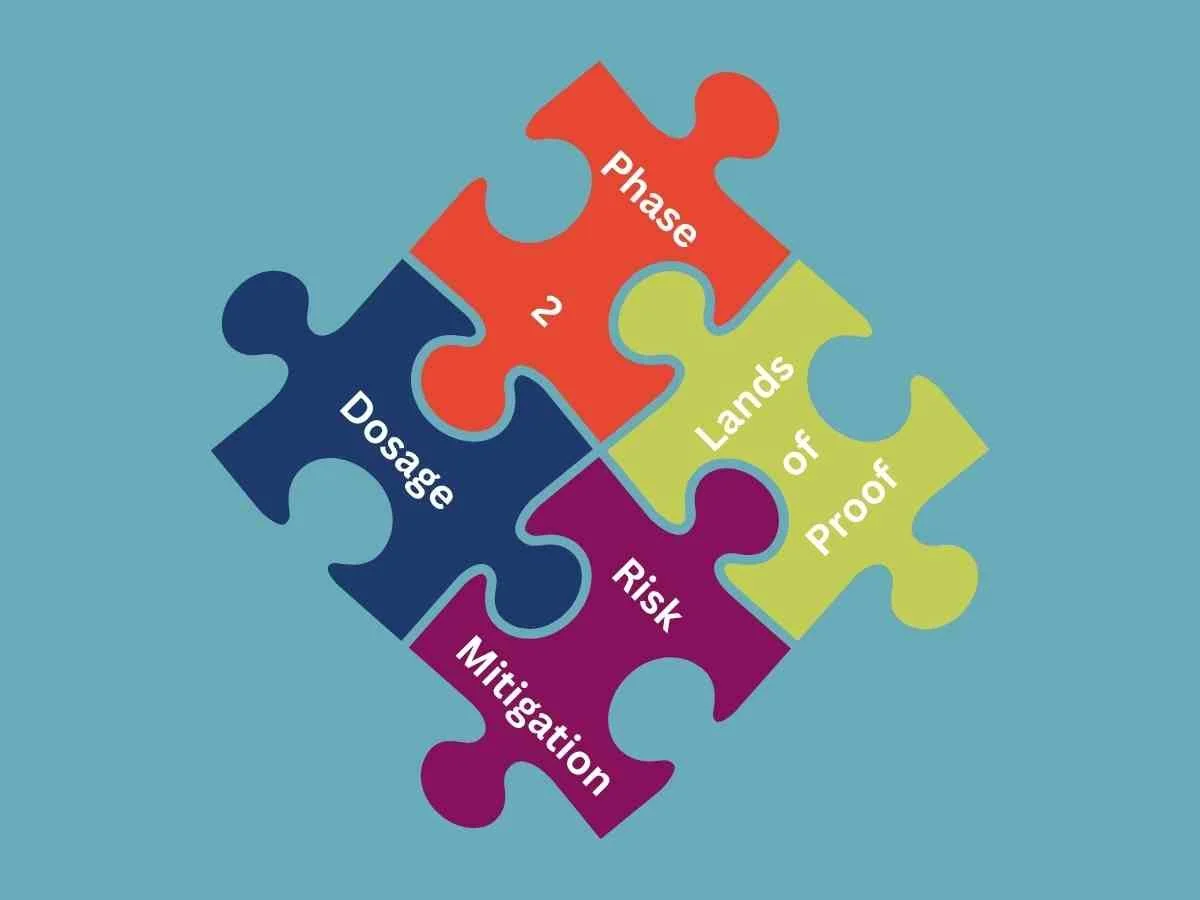
Phase 2 is the ultimate "make or break" moment for drug development and why cutting corners now leads to catastrophic failure later. This Guard Rail blog breaks down the essential risk-mitigation strategies needed to bridge the treacherous gap between initial proof of concept and a successful Phase 3 trial.
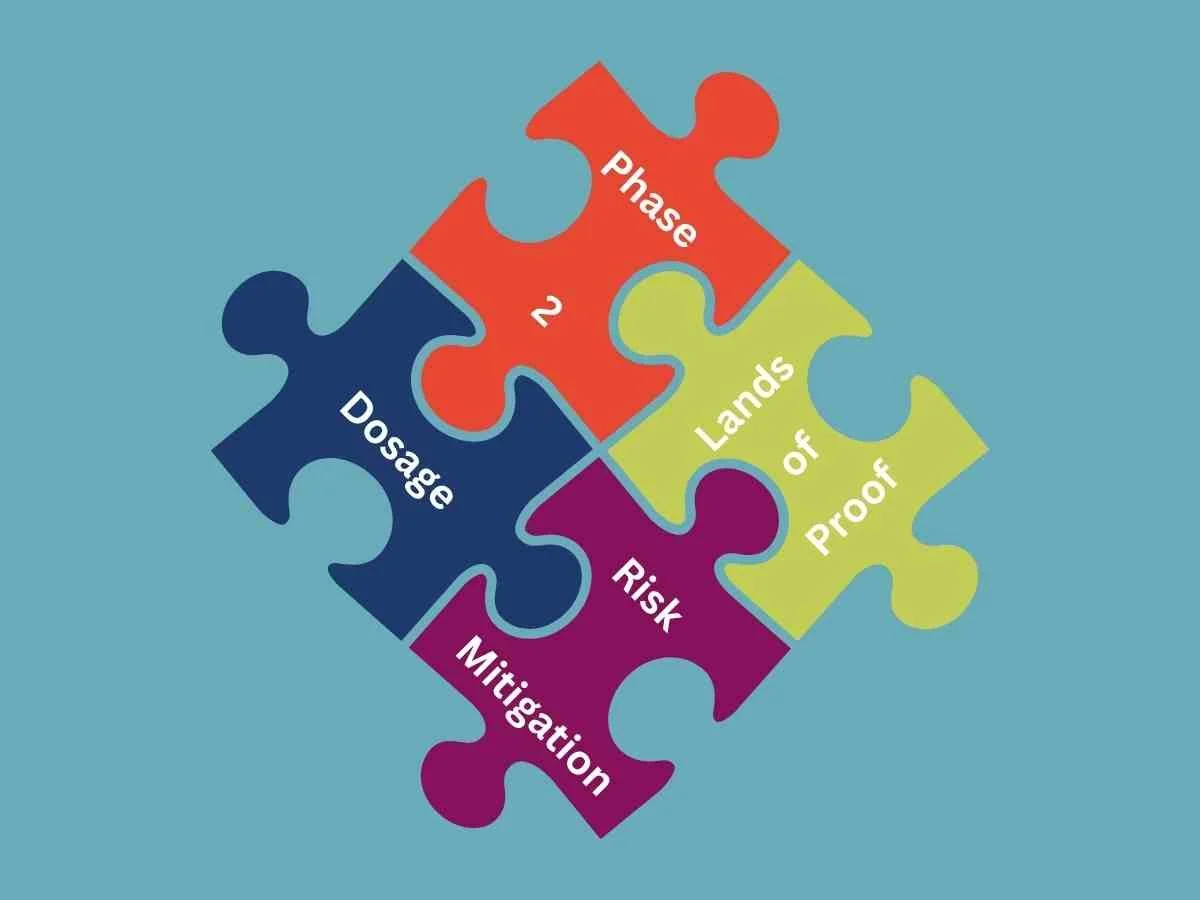
This week, we explore why Phase 2 is the ultimate "make or break" moment for drug development and why cutting corners now leads to catastrophic failure later. This Guard Rail blog breaks down the essential risk-mitigation strategies needed to bridge the treacherous gap between initial proof-of-concept and a successful Phase 3 trial.
By Michael Bronfman
In the world of drug development, Phase 2 is often called the "Lands of Proof." This is the moment when a company moves from testing safety in a few healthy people to seeing whether the drug actually works in patients with the disease. It is an exciting time, but it is also the most dangerous part of the journey.
Many teams make the mistake of thinking they can fix small problems later in Phase 3. They might say, "We will figure out the final dose later," or "We will refine the manufacturing process once we have more data." In the pharmaceutical industry, this "wait and see" approach is a recipe for disaster.
Risk mitigation must happen right now. If you do not resolve your biggest uncertainties during Phase 2, you are not just delaying a problem. You are risking billions of dollars and years of hard work.
The Massive Cost of Failure in Phase 3
The jump from Phase 2 to Phase 3 is a giant leap in terms of cost and complexity. While Phase 2 might involve a few hundred patients, Phase 3 often requires thousands.
If a drug fails in Phase 3 because of a risk that could have been identified earlier, the financial hit is devastating. According to reports from Deloitte, the cost to bring a single drug to market has climbed to over two billion dollars.
Most of that money is spent during the final stage. If you enter Phase 3 with a "weak" dose or a "fuzzy" understanding of which patients benefit most, you are gambling with the future of the company. Fixing a mistake in Phase 2 costs thousands. Fixing that same mistake in Phase 3 costs millions.
Solving the Dosage Puzzle
One of the biggest risks in Phase 2 is choosing the wrong dose. This is known as "dose finding."
If the dose is too low, the drug will not show enough benefit, and the trial will fail. If the dose is too high, the side effects might be too many for the government to approve it.
Many companies rush through this. They pick a dose that looks "good enough" so they can start the big trials faster. However, the Food and Drug Administration (FDA) has become much stricter about this. They want to see that you have tested several different doses to find the "sweet spot."
By spending the extra time in Phase 2 to run a robust dose-ranging study, you build a solid foundation. You go into Phase 3 with total confidence that you are giving patients the best possible chance of success.
Identifying the Right Patient Population
Not every patient with a specific disease reacts to a drug the same way. One of the best ways to mitigate risk is to figure out exactly who your "super responders" are.
During Phase 2, researchers look for biomarkers. These are biological signs in the blood or tissue that suggest a patient will respond well to the treatment.
If you ignore these signs and try to test the drug on everyone in Phase 3, your results might get "watered down." The drug might work great for 20 percent of people but not at all for the other 80 percent. If you mix them all together, the average result might look like the drug does not work.
By using Phase 2 to narrow down the target group, you make your Phase 3 trial much smaller, faster, and more likely to succeed. You can find more information on how patient selection impacts trials HERE.
Manufacturing and Supply Chain Hurdles
It is easy to make a small amount of a drug in a lab. It is very hard to make enough for ten thousand people while keeping the quality exactly the same every single time.
A major risk that teams "kick down the road" is the manufacturing process. They use a "Version 1" process for Phase 2 and plan to switch to a "Version 2" for Phase 3.
The problem is that the FDA considers the manufacturing process to be part of the drug itself. If you change how you make the drug, you have to prove that the "new" drug is the same as the "old" drug. This can lead to massive delays or even require you to redo your studies.
Addressing manufacturing risks during Phase 2 ensures that what you test in the final stages is exactly what will be sold in pharmacies. Consistency is the key to safety and approval.
The Regulatory Conversation
You should never treat the government regulators as a surprise at the end of the race. Risk mitigation involves talking to the FDA or the European Medicines Agency early and often.
Phase 2 is the perfect time for an "End of Phase 2" meeting. This is where you present your data and plan to the regulators for the big trial. If they have concerns about your safety data or your goals, you want to know that now.
Waiting until after Phase 3 to find out the FDA does not like your study design is a nightmare scenario. Early transparency reduces the risk of rejection and builds trust with the people who hold the keys to the market.
Protecting the Patients
Beyond the money and the business goals, the most important reason to mitigate risk is the people. Every person who signs up for a clinical trial is a volunteer who wants to help find a cure.
If we move into Phase 3 with known risks that we chose not to solve, we are putting those volunteers at unnecessary risk. We owe it to the patients to be as certain as possible about the safety and the logic behind the study before we ask thousands of people to participate.
High-quality science in Phase 2 leads to safer trials. When we prioritize risk management early, we protect the integrity of the medical profession and the lives of the people we serve.
Key Actions
To ensure a successful transition out of Phase 2, teams should focus on these three pillars:
Data Certainty: Do not settle for "maybe." Use Phase 2 to get clear answers on dose and efficacy.
Process Stability: Finalize how the drug is made and how it will be delivered before the big spend.
Open Dialogue: Work with regulators to make sure the finish line is clearly defined.
The motto for Phase 2 should always be: Fail fast or fix it now. Dealing with the hard truths today is the only way to ensure a breakthrough tomorrow. Waiting to resolve these issues later is not a strategy; it is a gamble that the industry simply cannot afford.
Don’t leave your clinical legacy to chance—master the "Lands of Proof" before the stakes become insurmountable. Contact Metis Consulting Services today to fortify your strategy, optimize your data, and turn your scientific vision into a regulatory reality.